Category Archives: Archive

BUILD class schedule available online

The list of fall 2020 Bulldogs United in Learning Drake (BUILD) classes is available online. To access the list, go to HR BUILD Classes under All Apps – Other Employee Apps on myDrake.

BUILD is a series of 1–2 hour presentations on topics relevant to faculty and staff. Classes will be held virtually. Most will offer a live virtual presentation, which allows for meaningful interaction with colleagues and the presenter. Presentations will also be recorded for later viewing.

The next class is Compassion Fatigue on Tuesday, Oct. 6, from 2–3 p.m.  Witnessing the trauma, grief, or aging of a loved one is the daily challenge of being a caregiver. This session explores the concept of compassion fatigue, what it looks like, how it affects both formal and informal caregivers in both a personal and professional context, as well as the resources available for building coping skills and practicing self-care. Presented by Scarlett Lunning from Employee & Family Resources.

To register for this or any class, please send an email to linda.feiden@drake.edu.

— Linda Feiden, Human Resources

September’s featured digital faculty member: David Plutschack

Each month, a faculty member, nominated by their dean, is recognized for their efforts to integrate innovative technology into their classroom. September’s digital faculty member of the month is David Plutschack, assistant professor of occupational therapy, College of Pharmacy and Health Professions. Read an interview with David below:

What course do you use this technology in? Currently, I am teaching the OTD 132 Orthotics and Positioning course, which is generally a very hands-on lecture and lab while on campus.

What type of technology (hardware/software) do you use? Prior to the COVID outbreak, I actually was frequently incorporating various forms of technology within my lectures and lab. I started using a mobile application called PhysioU in 2018 in the OTD 111 (Application of Kinesiology to Occupational Therapy) course and have continued using it this semester. Given the hands-on nature of this course, going virtual provided a new challenge. To combat this, I began using Zoom along with students using smartphone cameras as needed.

In what context do you use this technology (assessment/lecture/group work/etc.)? When on campus, we would typically spend about an hour working in small groups of 5-6 students on patient case studies. Students would work through complex case studies based on upper extremity diagnoses. In a virtual format, lectures are prerecorded using Panopto, but we meet live for one-hour weekly during our regularly scheduled time. Students are broken into small groups using Zoom breakout rooms and complete the case studies virtually. After about 30-45 minutes in the breakout rooms, we go back as a whole class and discuss the case studies as a group.

PhysioU is a mobile platform for occupational and physical therapy education. This website and application have been vital to delivering my labs virtual. Prior to the COVID outbreak, students would watch the videos prior to lab, then complete splinting live during lab. In a virtual platform, students use the videos and complete their splints at home on themselves, family members, or roommates (while maintaining social distancing). During lab times, Zoom is used for check-ins regarding lab assignments and grading purposes.

How does this type of technology align with your teaching pedagogy? Using technology is ingrained in my teaching philosophy and scholarship. Utilizing technology and various multimedia platforms to deliver occupational therapy pedagogy allows for all types of learners (visual, auditory, etc.) to grasp difficult concepts. Mobile technology such as webpages and mobile apps also provides students with the ability to develop hands-on clinical skills, which may be difficult from textbooks alone.

Where did you get the inspiration to make a change (colleague/seminar/administration/etc.)? I started researching mobile applications for teaching occupational therapy clinical skills in 2018 for the OTD 111 course and fell in love with PhysioU’s approach to technology and education. I was able to establish a great working relationship with the founders of PhysioU and have actually developed content as an author of the SplintPro portion of the website. This only further sparked my interest in technology in occupational therapy education

How long did it take for you to implement this technology? Implementing PhysioU into OTD 111 and OTD 132 was quite rapid. Students love it because it has videos of hands-on techniques, rather than text and a picture from textbooks. At the start of the COVID outbreak, utilizing Zoom had to occur quickly, but I was well versed on the platform and felt the transition went well.

Since transitioning to remote teaching, how has your use of this technology changed, if at all? To me, no big changes in using the PhysioU application. The only change is students are completing their splinting at home rather than in lab. Students were given home safety recommendations and home splint fabrication recommendations, since the videos on PhysioU were made with equipment regularly available in clinics and Drake OT labs. The equipment available at home varies between each student.

Overall, what lessons (if any) do you think you have learned while transitioning to remote teaching? I have been incredibly grateful for the Drake University occupational therapy students being flexible, resilient, and creative during this transition to remote teaching. They have made this transition much easier than I imagined. One lesson I have learned while teaching remotely is the extreme amount of preparation that goes in to deliver high quality remote teaching. Another is the importance of face-to-face time with my students. I find the Zoom live group work and lab check-ins weekly to be very valuable to student success. Keeping open communication is key.

Both before and during this transition, did Drake ITS assist you in implementing any of these technologies?  If so, how? No, I am pretty tech savvy, so I was able to set everything up personally.

Are you interested in trying out new technology in your classroom? Want help from ITS? Schedule a technology adoption consultation.

Want to learn more about using Panopto or Zoom in your course? Explore the knowledge base categories:

Panopto: https://drake.teamdynamix.com/TDClient/2025/Portal/KB/?CategoryID=17251

Zoom: https://drake.teamdynamix.com/TDClient/2025/Portal/KB/?CategoryID=18578&SIDs=7847

—Jon Hurdelbrink, CPHS, and Carla Herling, ITS

COVID-19 support resources

Drake has a variety of resources to assist faculty and staff during this ongoing pandemic. In an effort to make these resources more accessible, HR has consolidated them into one section on the HR web page. The web page can be found by going to to my.drake.edu and clicking on Human Resources under Commonly Used Apps. Then select COVID-19 Support Resources.

Resources include links to the Drake coronavirus website, and essential information within this site; Iowa childcare resources; DSM Tutor Connection; Supplemental Paid Leave Plan; link to Employee & Family Resources; Drake TEAMS Chat Groups; Doctors on Demand®; and additional health and wellness information.

— Linda Feiden, Human Resources

Faculty and staff flu shot clinics

There are a few openings left—sign up today to receive your flu shot. Human Resources purchased 300 flu vaccines to be provided at no cost to faculty and staff and administered by Drake CPHS student pharmacists and pharmacist faculty members.

Flu shot clinics will be held during morning hours on October 5, 7, 9, and 12. Those who wish to participate must register online at https://tinyurl.com/CPHSwellness2020 for an appointment.

This year’s employee flu clinic will be held in a “drive-up” format in Parking Lot 2 across from Shivers Basketball Practice Facility. Those participating will drive their car to the lot during their appointment time (or walk up if you are not driving), receive the vaccination, and then will be asked to wait in their car in the parking lot for the 15-minute, post-vaccination safety waiting period.

If you have any questions regarding the flu shots, please contact Nora Stelter, PharmD, Associate Professor, Pharmacy Practice at nora.stelter@drake.edu.

— Linda Feiden, Human Resources

Healthiest State Walk and 5-2-1-0 program

Grab your walking shoes and join this year’s Healthiest State Walk on Wednesday, Oct. 7.

To maintain social distancing, we are not going to meet as a group at a specific time to start the walk. Instead, we are asking everyone to take a break at any time during the day on Oct. 7 and go for a walk—at home or on campus.

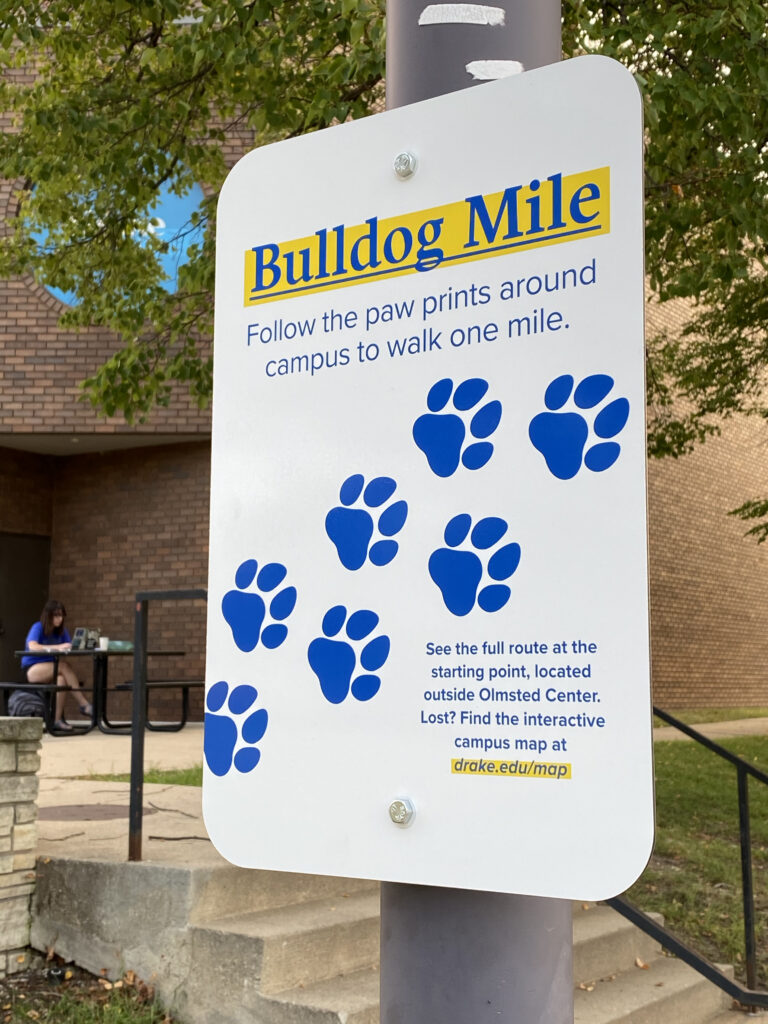
If you are working on campus, try out the new Bulldog Mile path. Follow the signs and giant blue paw prints on the sidewalks around campus. A map is posted east of the Olmsted Center. You may also view the route at drake.edu/map under Points of Interest.

Once you finish the Healthiest State Walk, send an email to linda.feiden@drake.edu to enter a drawing for a chance at prizes.

The Iowa Healthiest State walk is celebrated in October as part of Iowa’s Healthiest State Month initiative. In addition to the walk, the initiative is focusing on its 5-2-1-0 program throughout the month. The daily goal is to eat five fruits or vegetables, spend two hours or less of screen time outside of work, get at least one hour of physical activity, and consume zero sugary beverages.

Let’s begin our road to better health with the Healthiest State Walk!

— Linda Feiden, Human Resources

Send a postcard to your family

The Office of Academic Excellence and Student Success has made the decision to cancel in-person Family Weekend scheduled for Oct. 2–4. This decision aligns with University guidelines and public health recommendations as we continue to manage the spread of COVID-19.

While we are disappointed by this news, we are excited to offer you an opportunity to send your loved ones a postcard to greet them and thank them for their support this semester. You can pick up a postcard from the front desk of any of the residence halls or the Student Life Center in Olmsted. Simply grab a postcard, fill it out and return it to a box at your residence hall front desk or in the Student Life Center in Olmsted by Friday, Oct. 2. We will take care of mailing it.

— Marina Verlengia, New Student Programs

Drake joins additional tuition exchange program

Drake is now a participating member of the Council of Independent Colleges and Universities’ Tuition Exchange Program (CIC–TEP), which consists of around 440 member colleges and universities. This change broadens the opportunities for Drake employees and their eligible dependents to attend another institution of higher education tuition-free.

Drake also participates in the tuition exchange program offered through Tuition Exchange, Inc., which has over 670 participating institutions. More information about each of these tuition exchange programs may be found on HR’s Tuition Benefits webpage.

— Mary Alice Hill, Human Resources

Get to know Drake’s newest faculty

Drake University welcomed 18 new faculty members and two new deans for the 2020–2021 academic year. Coming from various backgrounds and communities, these new faces will help drive the University’s mission to provide an exceptional learning environment that prepares students for meaningful personal lives, professional accomplishments, and responsible global citizenship.

Learn more about the 2020–2021 new faculty cohort, including why they chose Drake and their field of study.

— Sandra Harris, Provost’s Office

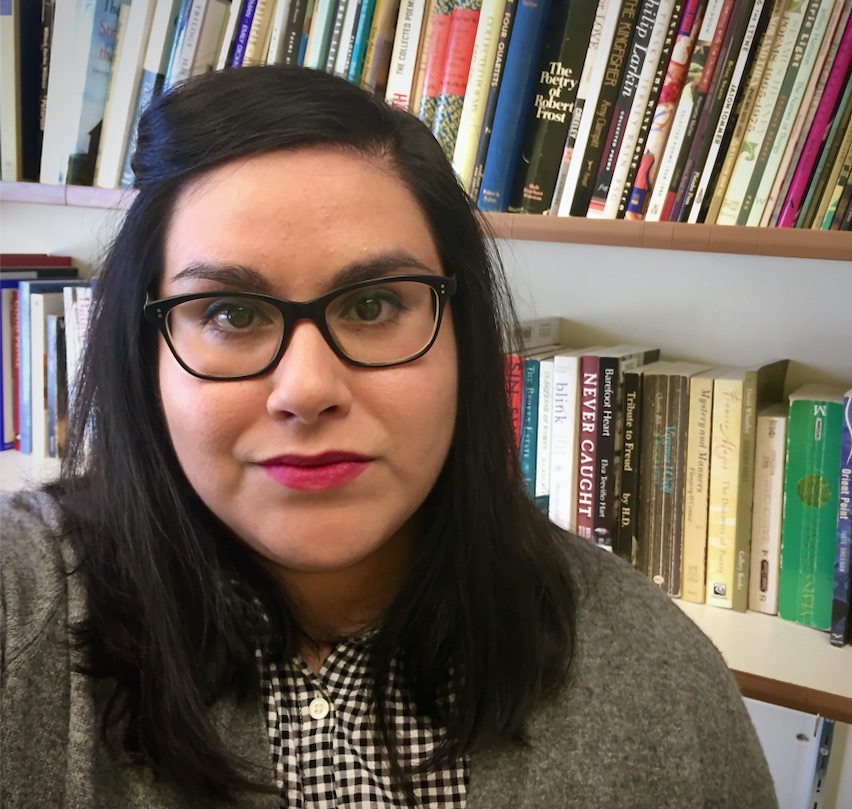
Voices of Drake: Leah Huizar, assistant professor of English

This Q&A is part of the story series Voices of Drake that highlights the diversity, ambition, and passion of the incredible people that make up our campus community. This week’s story is designed to celebrate and shine light on Latinx Heritage Month, Sept. 15–Oct. 15. It spotlights Leah Huizar, assistant professor of English.

Tell us about yourself.
I am a Mexican-American poet and writer originally from Southern California. Growing up, I was fortunate to be raised around a large family composed of not only my sisters and parents but also an extensive extended family of grandparents, aunts, uncles, and cousins. I love the cold waters of the Pacific Ocean and the great forests of my home state. Since moving away, I have lived on the East Coast, in the South, and now the Midwest. 

Tell us about your education. Where did you go to school and what did you study?
As an undergraduate, I was a double major in English and psychology. I also minored in biblical studies. Though I didn’t know it at the time, looking back, I see how these fields spoke to my longstanding interests in the forces that influence and regulate our lives. As an English major, my most transformative classes were on literary and critical theory. It was there that I first began to understand the ways in which systems and structures operate all around us—and how, through language and engagement, we can respond to them. After college, I went to Penn State for graduate school where I received my MFA.

How has your cultural heritage influenced the person are today/your views of the world/or your field of work?
As a poet, I most often write from the intersections of the personal and historic. What this has meant for me is that my Mexican-American identity shapes and motivates many of the kinds of questions I examine in my writing.

What creative projects are you working on right now or what have you been working on recently? What drew or draws you to this project?
My first book of poems was recently published by Noemi Press. It’s called Inland Empire and draws on the cultural and historic landscapes of the West Coast and the ways in which colonization, faith, and gendered injustices have shaped it. My current writing project takes on similar questions through an exploration of communication circuits. How do we make and share our voices? How are these obscured or suppressed in our wider culture?   

What kinds of courses do you teach? How do your courses connect to your writing life or fit within your broader academic vocation?
I teach poetry writing courses in the English department. I also have taught or will teach the Writing Seminar, US Latinx Literature, First Year Seminar, and Intro Women and Gender Studies. To me, each course is an opportunity to ask big questions of writing, of gender, and of ethnicity with really smart student scholars.

How do you hope students come to look at the world differently as a result of their work in your courses?
At every course level, and whether literature or poetry, my courses examine how we craft the world through language. Language is always high stakes and consequential. So, our ability to effectively, authentically, and persuasively use it is a dynamic kind of power to carry into the world. This is what we do as writers.

How long have you been at Drake? What is your favorite thing about working at Drake so far?
This is my second year at Drake! Among the many joys of working here, I am most impressed with Drake students. There are few things as wonderful as working with students who want to learn and are willing to stretch themselves intellectually.

What is your favorite thing about the Drake neighborhood?
I have really enjoyed visiting Mars Cafe for coffee and Lzaza Indo-Pak Cuisine for the chai tea served with lunch.

Who has been the biggest influence in your life and what lessons did that person teach you?
I’ve been fortunate to have had many brilliant women as mentors in my life. One influence has been my grandmother. She sees everything—an observer—and this is a central skill for a writer.

How do you like to spend your free-time? Tell us about your hobbies and interests.
Creativity is an important part of my life. In recent years, I’ve worked on bookmaking and letterpress printing. I collect antique printing presses which are big cast iron machines that work with metal or wood type. In the past, I’ve printed posters, booklets, and a chapbook of bilingual short stories.

This year is a year like no other. What advice would you like to give to a first-year student at Drake?
No doubt this year is challenging and yet I see students adapting and responding with hope and endurance. On a large scale, I see students rejecting injustice, inequity, and racism and defining the kinds of future they will accept from culture. It may be that students ought to advise the rest of us. If pressed, however, I would say please don’t hesitate to reach out to your professors when you need assistance. We want you to thrive!

The Bulldog Mile

Add some steps to your day while exploring campus with the Bulldog Mile! This bulldog-shaped, one-mile path around and through campus is perfect for easy walking, jogging, or running.

Most signs have been posted and blue paw prints placed strategically around the route. The main sign with a map of the route will be installed outside of Olmsted by the end of the month.

To view the route, go to drake.edu/map, click on the drop down tab next to Points of Interest, and click on The Bulldog Mile.

— Linda Feiden, Human Resources