Category Archives: Archive

Known HP Computer Issue May Affect Some Users

As students, faculty, and staff return to campus, ITS is reminding the University community about a known issue related to a recent HP BIOS update that may affect some Drake-managed Windows computers.

Users may encounter a blank blue screen after restarting or be prompted for a BitLocker recovery key. Although the behavior can be alarming, no data has been lost and the device is not damaged.

If you experience either of these symptoms, please contact ITS for assistance by submitting a Computer/Peripheral/Software Issue ticket, calling 515-271-3001, or visiting the lower level of Carnegie Hall with your device. An ITS technician can help restore access to your computer.

Additional information from HP is available here: Learn more about the BIOS update issue.

To receive ITS news posts via email, opt in by completing this form.

To receive SMS outage notifications, opt in by texting DrakeITSALERTS to phone 226787. Make sure you’re signed up to receive text Bulldog Alerts; check your settings via myDrake.

— Becky Klein, ITS

The Harkin Institute Announces Faculty Fellow Program and Faculty Fellow-in-Residence Program

The Harkin Institute for Public Policy and Citizen Engagement is seeking applicants for its Faculty Fellow Program and Faculty Fellow-in-Residence Program, which recognize Drake University faculty whose scholarship, creative activity, and public intellectual contributions align with and advance The Harkin Institute’s mission in fields related to public health, wellness, nutrition, agriculture, environmental health, retirement security, long-term care, labor and employment policy or history, or disability policy.

During their fellowship, Faculty Fellows will have opportunities to contribute to Harkin Institute projects, including research and publications; to serve as principal or associate investigators on Harkin Institute grants; to appear as panelists or presenters at Harkin Institute events; to present public lectures or presentations; and/or to take on contracted work on behalf of The Harkin Institute. They will style themselves a “Fellow of the Harkin Institute” when speaking, writing, or applying for funding related to The Harkin Institute’s mission and strategic priorities during the term of their fellowship. Tenured Faculty Fellows at the rank of Full Professor will be considered Senior Fellows.

Faculty Fellows will be included on The Harkin Institute website along with a brief bio and description of their work. Harkin Institute Faculty Fellowships are unremunerated unless (1) specific outside funding is secured in support of a fellow’s work or (2) the fellowship fulfills, in part, a faculty member’s sabbatical reassignment.

Harkin Institute Faculty Fellowships fall into two categories:

  • Harkin Institute Faculty Fellowships are unremunerated affiliations available to Drake faculty members who demonstrate high-quality, ongoing peer-reviewed research or creative activity or public scholarship in an area related to The Harkin Institute’s Mission. Faculty Fellows are not under the direction of Harkin Institute staff unless they opt to take part in a Harkin Institute grant, contract, initiative, or project.
  • Harkin Institute Faculty Fellowships in Residence recognize Drake Faculty reassigned to The Harkin Institute during their sabbatical and whose sabbatical project contributes directly to a Harkin Institute initiative or project. Their work falls at least partly under the direction of The Harkin Institute’s executive director and a director of policy.

The deadline for application for FY 2027 Fellowships is September 15. Application materials (see below) should be emailed to harkininstitute@drake.edu. Inquiries should be sent to Craig Owens, Executive Director, cc’ing Mindy Jones, Chief of Staff and Director of Operations.

Faculty Fellows are appointed to renewable fiscal-year terms either through special invitation or via application:

  • By Invitation: The Executive Director of The Harkin Institute will contact faculty directly with an invitation to consider accepting a one-year renewable Faculty Fellowship and to provide an updated vita for review. Deans and department chairs may nominate members of their faculty via email to the Executive Director of The Harkin Institute.
  • By Application:
    • Faculty Fellowship (non-residential) require (as a single document)
      • A brief statement (350-500 words) explaining the applicant’s qualifications, including how their work intersects with the mission of the institute.
      • The name of one professional reference who can speak to the quality of the applicant’s scholarship or creative activity.
      • A complete, up-to-date cv.
    • Faculty Fellowship in Residence application
      • Applicants will meet in-person with the Executive Director to discuss residential opportunities in the fall of their application for sabbatical.
      • The formal application will consist of a copy of the applicant’s sabbatical application and supporting materials, including complete, up-to-date vita. It will require that the applicant affirm that they have consulted with their dean and their department chair or program director before accepting any offer of fellowship.
      • Fellowships in Residence require approval of the sabbatical request.
      • Residential Fellows will spend two-to-three (2-3) days weekly in residence at The Tom and Ruth Harkin Center except when their sabbatical project requires offsite travel.
      • Residential Fellowships require the final approval of the applicant’s dean, to be sought by a member of The Harkin Institute leadership.

— Mandy McClure, Harkin Institute for Public Policy and Citizen Engagement

Join Us for WellCon Oct. 29: Drake’s 4th Annual Wellness Conference

WellCon 26, the fourth annual Wellness Conference for Drake students, faculty, and staff, will take place Oct. 29 from 3–5 p.m. in Upper Olmsted. You’ll have the opportunity to win various prizes and engage in a variety of wellness activities hosted by on- and off- campus partners. With a focus on the six dimensions of wellness—physical, emotional, intellectual, social, occupational, and spiritual—the conference is a great opportunity to reset and prioritize your well-being at the midpoint of the semester. We invite you to register and join us!

Register to attend: WellCon 2026 Attendee Registration – Fill out form

Register as a student organization: WellCon 2026 Student Org. Interest Form – Fill out form

— McKinleigh Holland, CPHS

Support for Caregivers

Iowa State University Extension and Outreach is offering Powerful Tools for Caregivers, an evidence-based educational program that helps caregivers develop practical skills to reduce stress, improve communication, manage difficult emotions, and prioritize their own well-being while caring for others.

This six-week program is designed for family caregivers of adults with chronic conditions and parents or caregivers of children with special health and behavioral needs. Participants learn tools and strategies they can apply immediately to help them thrive in their caregiving role.

Learn more about upcoming classes and registration opportunities at https://go.iastate.edu/EIFSEH.  NOTE: Caregivers of cancer survivors may use the coupon code CANCERIOWA to waive the registration fee.

For more information about the program, visit the Health and Human Sciences Extension and Outreach website or contact Malisa Rader at mrader@iastate.edu or 515-708-0622.

— Linda Feiden, Human Resources

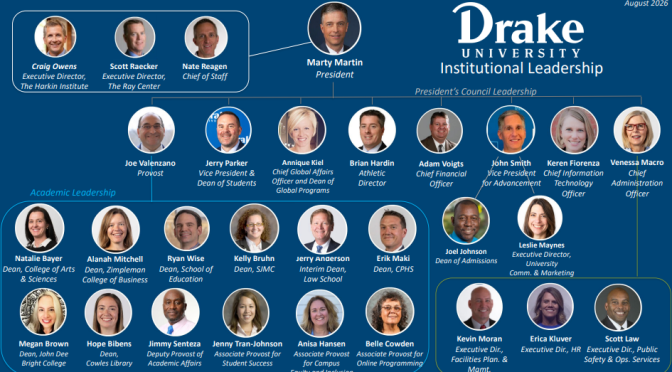
Get to Know Drake’s Leadership

This organizational view of institutional leadership is a great way to get to know the leadership here at Drake. Instead of just a boring text view, you will see photos of each person. Bonus: if you click on a person’s image, you will be directed to their corresponding web page to learn more.  This can also be found on the Office of the President page and is maintained by the President’s Office. It is a handy tool, especially if you are new to Drake.

— Nate Reagen, Office of the President

Upcoming Blackboard Open Office Hours

On Aug. 26, faculty are invited to drop in and meet with a learning design specialist—in person or via Teams—for hands-on assistance with Blackboard.

Get your Blackboard pages ready for the new semester! Faculty are invited to drop in and meet with a learning design specialist for hands-on assistance.

Wednesday, August 26

Time: 1 p.m. – 4 p.m.
Drop-in Location: Howard Hall Faculty Lounge (Room 212)
Microsoft Teams Virtual Option: Available via Teams

If you have questions outside of Blackboard Office Hours:

  • Interact with this Fall 2026 Course Prep slideshow for a summary of updates to Blackboard, best practices for sharing course materials, a framework for setting AI expectations, increasing the accessibility of your courses, and more!
  • Review the help guides for faculty, organized by topic, in Drake’s Knowledge Base.
  • Go directly to the upgraded Blackboard LMS Help Center.
  • Click the question mark icon in the lower-right corner of most Blackboard pages to open Blackboard’s related help pages.

— Shannon Hilscher, Drake Online, Learning Design Services

Your Guide to Using On the Go: Important Entry and Payment Updates

Starting this semester, everyone will need to use the Grubhub app to enter On the Go.

Getting Started

1. Download the Grubhub app and select Campus Dining.

2. Search for Drake University and select your category: undergraduate class year, graduate student, faculty/staff, or guest.

3. In Payment, connect your campus ID. You may also add a credit/debit card if you choose.

Entering On the Go

Open Grubhub → select On the Go under Restaurants → tap Get Access → scan the QR code at the entrance.

Payment & Entry — Important!

You can pay with Dining Dollars, Bulldog Bucks, or Commuter Dollars, as well as a credit/debit card if connected.

Please remember:

*Select your payment method EVERY TIME you enter. If you don’t, your default primary payment method (your credit/debit card) will be charged.

*You must have at least $25 available on your selected payment method to enter.

*ONE PERSON PER QR CODE. Each person must scan their own QR code.

* If multiple people enter using one QR code, one account will be charged for all items purchased.

We’re excited to welcome you back and make grabbing your favorite snacks, drinks, and essentials easier than ever!

— Taylor Webb, Dining Services

E-Scooter and Personal Transportation Device Safety on Campus

Drake University Reminds Community of Safety Expectations for E-Scooters and Other Personal Transportation Devices

As the use of electric scooters and other personal transportation devices continues to grow across campus, Drake University is reminding students, faculty, staff, and visitors of existing policies and safety expectations designed to maintain a safe and pedestrian-friendly campus environment.

The University has received reports of increasing scooter traffic both outdoors and inside campus buildings. While these devices offer a convenient means of transportation, their use must be balanced with the safety of the entire campus community.

Personal Transportation Devices Prohibited Inside Campus Buildings

Drake University’s current policy prohibits the operation of electric scooters and other personal transportation devices inside University buildings. In addition, electric scooters and other personal transportation devices that are not designated mobility devices for ADA-related use are not permitted to be brought into campus buildings.

Hallways, classrooms, offices, laboratories, common areas, and other interior spaces are designed for pedestrian traffic. The presence and operation of scooters and similar devices inside buildings creates unnecessary safety hazards, particularly in confined spaces, stairwells, doorways, and areas with limited visibility.

The University recognizes that mobility devices used as accommodations under the Americans with Disabilities Act (ADA) are distinct from recreational or convenience-based transportation devices and are not affected by this restriction.

Drake Remains a Pedestrian-Friendly Campus

Drake University is committed to maintaining a campus environment where pedestrians can move safely throughout academic, residential, and recreational spaces. Students and employees should expect that campus walkways are shared spaces where courtesy, awareness, and responsible operation of personal transportation devices are essential.

Individuals using electric scooters, e-bikes, skateboards, longboards, one-wheel devices, and similar forms of personal transportation are expected to:

  • Operate their devices safely and responsibly.
  • Yield to pedestrians at all times.
  • Maintain speeds appropriate for pedestrian traffic and environmental conditions.
  • Exercise caution when approaching intersections, building entrances, crosswalks, and areas with limited visibility.
  • Avoid reckless, aggressive, or distracted operation.
  • Follow all applicable University policies and local laws governing the use of these devices.

Users should remember that many scooters and other electric-powered devices operate quietly, making it difficult for pedestrians to hear them approaching. Extra caution should be exercised in heavily traveled areas of campus.

Policy Review Underway

The Department of Public Safety, Environmental Health & Safety, and Student Affairs are currently reviewing existing practices and policies related to scooters and other personal transportation devices. The review is intended to ensure that University expectations remain consistent with Drake’s commitment to safety, accessibility, and a pedestrian-friendly campus environment.

Additional information and guidance will be shared with the campus community as this process moves forward.

Reporting Safety Concerns

Community members who observe unsafe operation of scooters or other personal transportation devices, whether inside or outside campus buildings, are encouraged to promptly contact the Department of Public Safety. Timely reporting allows the University to address concerns, identify individuals involved when appropriate, and take action to help prevent injuries and future incidents.

Maintaining a safe campus is a shared responsibility. Through responsible use of personal transportation devices and respect for fellow community members, we can ensure that Drake remains a welcoming and safe environment for everyone.

— Scott Law, Executive Director, Public Safety & Operational Services