All posts by Chelsea Funk

Call for Travel Seminar Proposals for J-Term 2028

The call for travel seminar proposals for J-Term 2028 is now open

If you are considering proposing a travel seminar, your first step is to set up a meeting with Chelsea Funk to discuss your ideas and intent to propose.

All seminars hoping to travel for J-Term 2028 must submit a proposal. There is only one proposal submission link, and all fields must be completed.

Want More Info? Travel Seminar resources are available on our Global Affairs internal site. The internal site replaces our previous PDF and has information on:

Dates & Deadlines:

  • Submission: Sunday, October 18, 2026 (11:59pm)
    • No late applications will be accepted; contact Chelsea with any questions or concerns ahead of the deadline
  • Department & Dean Approvals: Thursday, October 22, 2026
  • Decision Notification: end of October 2026

 Proposal Link & Instructions:

The proposal submission is now being collected through Via TRM (not Qualtrics).

  1. Set up your Via profile (https://drake.via-trm.com/authV2/welcome)
    • Click “Go to Portal” to use your Drake SSO credentials; accept Terms & Conditions
  2. Once signed in, use this link to locate the Travel Seminar Proposal (drake.via-trm.com/program_brochure/38102)
  3. You can read through the relevant details on the proposal landing page. When you’re ready, click “Apply” in the top right corner to open the proposal application.
  4. You may stop & save your progress at any time using the “Save” button. Once you are finished, click “Submit”.

Please contact Chelsea with any questions ahead of the deadline. The EAPIC committee looks forward to reviewing your proposals!

— Chelsea Funk, Global Affairs

Last Call for Spring 2027 Study Abroad

If you’ve been thinking about studying abroad, this is your sign! The deadline to apply for Spring 2027 study abroad is today, Sept. 15. Don’t miss the opportunity to spend a life-changing semester at one of the numerous destinations Drake students can study, including our faculty-led DU Spain and DU Korea semester programs. 

Act now and submit your application through Via Global and schedule a one-on-one advising session through Starfish to hear more about living and learning abroad. Questions? Email us at studyabroad@drake.edu

— Emily Erschen, Global Engagement

Harkin Institute Announces Faculty Fellow Program and Faculty Fellow-in-Residence Program

The Harkin Institute for Public Policy and Citizen Engagement announces its Faculty Fellow Program and Faculty Fellow-in-Residence Program, which recognize Drake University faculty whose scholarship, creative activity, and public intellectual contributions align with and advance The Harkin Institute’s mission in fields related to public health, wellness, nutrition, agriculture, environmental health, retirement security, long-term care, labor and employment policy or history, or disability policy.

During their fellowship, Faculty Fellows will have opportunities to contribute to Harkin Institute projects, including research and publications; to serve as principal or associate investigators on Harkin Institute grants; to appear as panelists or presenters at Harkin Institute events; to present public lectures or presentations; and/or to take on contracted work on behalf of The Harkin Institute. They will style themselves a “Fellow of the Harkin Institute” when speaking, writing, or applying for funding related to The Harkin Institute’s mission and strategic priorities during the term of their fellowship. Tenured Faculty Fellows at the rank of Full Professor will be considered Senior Fellows.

Benefits of the fellowship include:

  • Support from THI in securing and managing grants and grant compliance.
  • Opportunities to collaborate with policy directors on current Harkin Institute projects (at the request of Fellows).
  • Research and administrative assistance from student associates, including assistance with document and presentation formatting.
  • Personalized Harkin Institute Fellow business cards.

Faculty Fellows will be included on The Harkin Institute website along with a brief bio and description of their work. Harkin Institute Faculty Fellowships are unremunerated unless (1) specific outside funding is secured in support of a fellow’s work or (2) the fellowship fulfills, in part, a faculty member’s sabbatical reassignment.

Harkin Institute Faculty Fellowships fall into two categories:

  • Harkin Institute Faculty Fellowships are unremunerated affiliations available to Drake faculty members who demonstrate high-quality, ongoing peer-reviewed research or creative activity or public scholarship in an area related to The Harkin Institute’s Mission. Faculty Fellows are not under the direction of Harkin Institute staff unless they opt to take part in a Harkin Institute grant, contract, initiative, or project. 
  • Harkin Institute Faculty Fellowships in Residence recognize Drake Faculty reassigned to The Harkin Institute during their sabbatical and whose sabbatical project contributes directly to a Harkin Institute initiative or project. Their work falls at least partly under the direction of The Harkin Institute’s executive director and a director of policy.

The deadline for application for FY 2027 Fellowships is September 25. Application materials (see below) should be emailed to harkininstitute@drake.edu. Inquiries should be sent to Craig Owens, Executive Director, cc’ing Mindy Jones, Chief of Staff and Director of Operations.

Faculty Fellows are appointed to renewable fiscal-year terms either through special invitation or via application:  

  • By Invitation: The Executive Director of The Harkin Institute will contact faculty directly with an invitation to consider accepting a one-year renewable Faculty Fellowship and to provide an updated vita for review. Deans and department chairs may nominate members of their faculty via email to the Executive Director of The Harkin Institute.  
  • By Application: Each August, OnCampus will publish a call for applications.  

Faculty Fellowship (non-residential) require (as a single document) 

  • A brief statement (350-500 words) explaining the applicant’s qualifications, including how their work intersects with the mission of the institute.  
  • The name of one professional reference who can speak to the quality of the applicant’s scholarship or creative activity.  
  • A complete, up-to-date cv. 

Faculty Fellowship in Residence: 

  • Applicants will meet in-person with the Executive Director to discuss residential opportunities in the fall of their application for sabbatical.  
  • The formal application will consist of a copy of the applicant’s sabbatical application and supporting materials, including complete, up-to-date vita. It will require that the applicant affirm that they have consulted with their dean and their department chair or program director before accepting any offer of fellowship. 
  • Fellowships in Residence require approval of the sabbatical request.  
  • Residential Fellows will spend two-to-three (2-3) days weekly in residence at The Tom and Ruth Harkin Center except when their sabbatical project requires offsite travel.   
  • Residential Fellowships require the final approval of the applicant’s dean, to be sought by a member of The Harkin Institute leadership. 

— Mandy McClure, The Harkin Institute

Sign Up for Intramural Bags Tournament Before Sept. 30

Intramural deadlines are approaching; sign up before it is too late. The Bags tailgate Tournament is taking place during family weekend at Drake Stadium during the Drake Football game vs Dayton. Students can play with anyone, including family members. At least one player per team must be able to register on IMLeagues. All Non-Drake Students require a ticket to the game for entry. Sign up for all Intramurals using the DrakeRec app or by visiting the registration portal online.

Bags Tailgate Tournament:

Registration deadline: Sept. 30th at 4 p.m.
Season start: October. 3rd

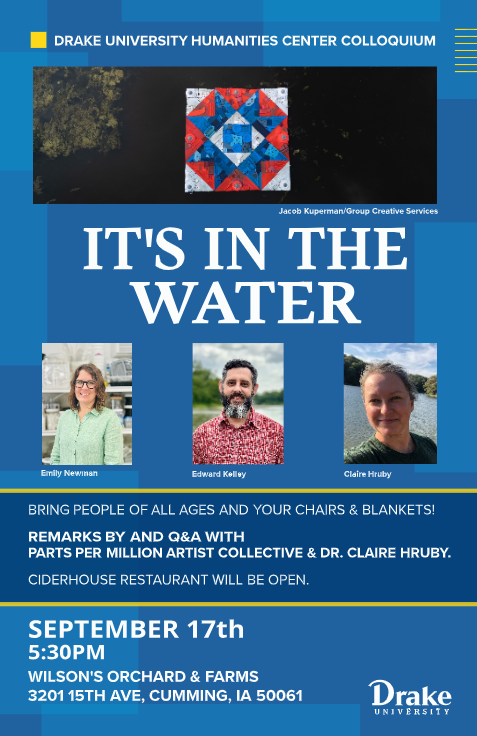
Learn About Water Quality at “It’s in the Water” Sept. 17, Wilson’s Orchard

The Humanities Center Colloquium invites you to “It’s in the Water” at 5:30 p.m. on Sept.17 at Wilson’s Orchard and Farms in Cumming (3201 15th Ave, Cumming, IA 5006)
 
Art Professors Emily Newman and Edward Kelley will share about the nitrate removal sculpture they created and installed. Environmental Science Professor Claire Hruby will help us understand more about water quality in Iowa.
 
We’ll learn about art and activism, and water and enjoy light refreshments together (Ciderhouse Restaurant will be open too).
We’ll meet at the pond and see the sculpture there while we learn, so bring lawn chairs / blankets. People of all ages / families are welcome.

— Inbal Mazar, Associate Professor of Spanish

See Something, Say Something: Why Reporting Matters

One of the most important ways every member of the Drake community can contribute to campus safety is by reporting concerns when they arise.

Most unfamiliar people on campus have legitimate reasons to be here. However, there are times when individuals may be attempting to access buildings without authorization, trespassing, or engaging in behavior that raises safety concerns. If you observe suspicious activity, trust your instincts and report it.

If you notice someone attempting to enter a secured facility, lingering in restricted areas, or acting in a way that seems unusual:

  • Do not confront the individual.
  • Maintain a safe distance.
  • Move to a well-lit, populated area.
  • Contact Drake Public Safety at 515-271-2222.
  • Call 911 if there is an immediate threat to life or safety.

The same principle applies after dark. If you are walking on campus at night and observe suspicious activity, change your route, if necessary, move toward populated areas, and contact Public Safety as soon as it is safe to do so.

No concern is too small. Public Safety would rather investigate a situation and determine everything is okay than miss an opportunity to assist someone who may need help.

Campus safety is a shared responsibility, and timely reporting helps prevent situations from escalating while keeping our community safe and welcoming for everyone.

— Scott Law, Public Safety & Operational Services

Diverse Student/Alumni Welcome Receptions

The Office of Alumni Relations reaffirms Drake’s commitment to diversity by recognizing and nurturing different identities. Starting this week, Alumni Relations will host two receptions to welcome our LGBTQ+ and BIPOC students to campus for another great year. These welcome receptions serve to create community among diverse students, alumni, faculty, and staff. For students, this is an opportunity to meet individuals like you who have been where you are. And of course, there will also be refreshments (and Griff III…shhh)! 

On Thursday, Sept. 17, from 5–7:30 p.m., we welcome all BIPOC students, alumni, faculty/staff of color and allies for the Multicultural Welcome Reception.

Then, on Thursday, Sept. 24, from 5–7:30 p.m., we welcome all LGBTQ+ students, alumni, faculty/staff, and allies to the Alumni House for the Rainbow Welcome Reception.

— Greg Lin, Alumni Relations

Call for Alumni Volunteer Opportunities

Last academic year, more than 1,000 Drake alumni volunteered their time and talents back to Drake for almost 1,500 different volunteer opportunities. We love seeing our Drake alums be all in this together and give back, and we need your help to keep it going.  

The Office of Alumni Relations will release its Fall 2026 Alumni Volunteer Newsletter in October 2026 and need your help to identify any upcoming volunteer opportunities where you might want assistance from alums. This could be from working an event to speaking in a class or to a student group to providing consulting on a project or even being a featured alumni on social media or in a communications story or profile.  

If you have any volunteer opportunities you’d like us to advertise to our alumni, please email Gregory Lin at gregory.lin@drake.edu.  

— Greg Lin, Alumni Relations

Known HP Computer Issue May Affect Some Users

As students, faculty, and staff return to campus, ITS is reminding the University community about a known issue related to a recent HP BIOS update that may affect some Drake-managed Windows computers.

Users may encounter a blank blue screen after restarting or be prompted for a BitLocker recovery key. Although the behavior can be alarming, no data has been lost and the device is not damaged.

If you experience either of these symptoms, please contact ITS for assistance by submitting a Computer/Peripheral/Software Issue ticket, calling 515-271-3001, or visiting the lower level of Carnegie Hall with your device. An ITS technician can help restore access to your computer.

Additional information from HP is available here: Learn more about the BIOS update issue.

To receive ITS news posts via email, opt in by completing this form.

To receive SMS outage notifications, opt in by texting DrakeITSALERTS to phone 226787. Make sure you’re signed up to receive text Bulldog Alerts; check your settings via myDrake.

— Becky Klein, ITS

The Harkin Institute Announces Faculty Fellow Program and Faculty Fellow-in-Residence Program

The Harkin Institute for Public Policy and Citizen Engagement is seeking applicants for its Faculty Fellow Program and Faculty Fellow-in-Residence Program, which recognize Drake University faculty whose scholarship, creative activity, and public intellectual contributions align with and advance The Harkin Institute’s mission in fields related to public health, wellness, nutrition, agriculture, environmental health, retirement security, long-term care, labor and employment policy or history, or disability policy.

During their fellowship, Faculty Fellows will have opportunities to contribute to Harkin Institute projects, including research and publications; to serve as principal or associate investigators on Harkin Institute grants; to appear as panelists or presenters at Harkin Institute events; to present public lectures or presentations; and/or to take on contracted work on behalf of The Harkin Institute. They will style themselves a “Fellow of the Harkin Institute” when speaking, writing, or applying for funding related to The Harkin Institute’s mission and strategic priorities during the term of their fellowship. Tenured Faculty Fellows at the rank of Full Professor will be considered Senior Fellows.

Faculty Fellows will be included on The Harkin Institute website along with a brief bio and description of their work. Harkin Institute Faculty Fellowships are unremunerated unless (1) specific outside funding is secured in support of a fellow’s work or (2) the fellowship fulfills, in part, a faculty member’s sabbatical reassignment.

Harkin Institute Faculty Fellowships fall into two categories:

  • Harkin Institute Faculty Fellowships are unremunerated affiliations available to Drake faculty members who demonstrate high-quality, ongoing peer-reviewed research or creative activity or public scholarship in an area related to The Harkin Institute’s Mission. Faculty Fellows are not under the direction of Harkin Institute staff unless they opt to take part in a Harkin Institute grant, contract, initiative, or project.
  • Harkin Institute Faculty Fellowships in Residence recognize Drake Faculty reassigned to The Harkin Institute during their sabbatical and whose sabbatical project contributes directly to a Harkin Institute initiative or project. Their work falls at least partly under the direction of The Harkin Institute’s executive director and a director of policy.

The deadline for application for FY 2027 Fellowships is September 15. Application materials (see below) should be emailed to harkininstitute@drake.edu. Inquiries should be sent to Craig Owens, Executive Director, cc’ing Mindy Jones, Chief of Staff and Director of Operations.

Faculty Fellows are appointed to renewable fiscal-year terms either through special invitation or via application:

  • By Invitation: The Executive Director of The Harkin Institute will contact faculty directly with an invitation to consider accepting a one-year renewable Faculty Fellowship and to provide an updated vita for review. Deans and department chairs may nominate members of their faculty via email to the Executive Director of The Harkin Institute.
  • By Application:
    • Faculty Fellowship (non-residential) require (as a single document)
      • A brief statement (350-500 words) explaining the applicant’s qualifications, including how their work intersects with the mission of the institute.
      • The name of one professional reference who can speak to the quality of the applicant’s scholarship or creative activity.
      • A complete, up-to-date cv.
    • Faculty Fellowship in Residence application
      • Applicants will meet in-person with the Executive Director to discuss residential opportunities in the fall of their application for sabbatical.
      • The formal application will consist of a copy of the applicant’s sabbatical application and supporting materials, including complete, up-to-date vita. It will require that the applicant affirm that they have consulted with their dean and their department chair or program director before accepting any offer of fellowship.
      • Fellowships in Residence require approval of the sabbatical request.
      • Residential Fellows will spend two-to-three (2-3) days weekly in residence at The Tom and Ruth Harkin Center except when their sabbatical project requires offsite travel.
      • Residential Fellowships require the final approval of the applicant’s dean, to be sought by a member of The Harkin Institute leadership.

— Mandy McClure, Harkin Institute for Public Policy and Citizen Engagement