Get an additional 30% off clearance items at the University Book Store Thursday, July 25–Wednesday, Sept. 11.
–Donna Hallstrom, University Bookstore

Get an additional 30% off clearance items at the University Book Store Thursday, July 25–Wednesday, Sept. 11.
–Donna Hallstrom, University Bookstore
We are deeply saddened to share the passing of Garry Frank, professor emeritus of public administration.
Garry Frank was born on April 12, 1948 in Carroll, Iowa and passed away on July 7, 2019. He was 71.
Garry Frank was a professor of public administration in Drake University’s College of Business and Public Administration. During his 34-year tenure, he received two distinguished professorships, the Thomas F. Sheehan Distinguished Professor of Public Administration as well as the Baum Chair of Ethics and the Professions. Garry specialized in instructing, writing, and speaking on ethics along with corresponding policy issues in public service, nonprofit groups, and private industry.
Established in 2015, the Dr. Garry L. Frank Legacy Award is presented annually to an MPA alumnus, who over the course of his or her career has exemplified the ideals of innovation, impact, and engagement.
Garry was laid to rest on Friday, July 12 at Resthaven Cemetery Mausoleum in West Des Moines, Iowa.
–Madeline Mongar-Brodie, College of Business & Public Administration
Professor Emeritus of Mathematics and Computer Science Kenneth J. Kopecky, who taught at Drake University for 42 years, died on July 6, 2019, at the age of 82.
Kenneth was born in Cedar Rapids, Iowa to Mary and Wesley Kopecky. Survivors include his wife Betty of 56 years; daughters, Jill Croft (Kevin) and Jane Hall; grandchildren, Katelyn Hall, Andrew Croft, and Emily Croft; sister, Sally Alvarez (Dennis) and many nieces and nephews. Ken’s brother, Duane predeceased him.
Ken received his B.S, M.S, and Ph.D. degrees from Iowa State University in mathematics, physics, and electrical engineering. Ken did post-doctorate study in computer science and computer research for NASA at the Jet Propulsion Laboratory in Pasadena, California, and at the Marshall Space Flight Center in Huntsville, Alabama. He worked on experiments for the space shuttle.
Professor Kopecky expanded the Computer Science Department at Drake University with grants he received with his NASA contracts. He sent two of his computer science students to the Jet Propulsion Laboratory for summer internships with his NASA funded contracts. He taught students to write computer programs in many different computer languages. He loved teaching and passed that love on to many of his student, who also became teachers, professors, and researchers.
Ken was a Drake Relays official for 52 years and was nominated to the Drake Relays Wall of Fame. He was a certified USA Track and Field official, and an official for the Iowa State Boys and Girls Annual Track meet at Drake University for many years. Ken was a well-known Iowa runner and bicyclist, winning many trophies, plaques, medals, and ribbons in races.
He was admired by his students, fellow professors, and friends and called “Kope” by many.
Ken’s family would like to thank Care Initiatives Hospice, and the kind resident assistants and staff at Edencresst Assisted Living in Beaverdale, who cared for him in the last year of his life and to all of the professors, students, family, and friends who visited Ken there.
Ken will be buried at Resthaven Cemetery in West Des Moines in a private family service. In lieu of flowers, the family would like to suggest contributions in memory of Ken be direct to the Professor Kenneth J. Kopecky Computer Science and Mathematics Scholarship Fund at Drake University.
To ensure the continuing digital security of our students, faculty, and staff, we are making several changes to our password creation process.
These changes are as follows:
Strong passwords are a key defense against phishing and other online attacks. You are required to change your Drake password annually, but you can change it more frequently. Learn more at Changing your Password (How-to).
–Carla Herling, ITS
Headshots are free for all students, faculty, and staff at Drake University.
Monday, August 19, 1:30 p.m.–2:30 p.m.
Meredith Hall, 2nd Floor Hallway.
–Annie Spadt, University Communications and Marketing
Sodexo has partnered with Drake to update the Food Service Exclusivity Policy. Beginning July 1, Drake constituents may use a food service provider other than Sodexo if the total cost of the food service is less than $60. If it is greater than $60, Sodexo should be your provider, unless you first obtain an approved, signed waiver from the appropriate Budget Manager as well as the catering director of Drake Dining (Sodexo). This amount had previously been set at $25. Please remember that you are responsible for all clean up after the event when you are using an alternate vendor.
Please contact caron.findlay@drake.edu if you have questions.
–Caron Findlay, Office of Finance & Administration
It is with heavy hearts we share the passing of Jack Gerlovich, professor emeritus of science education.
Jack Gerlovich was born on June 14, 1946 and passed away on June 26, 2019. Jack was a resident of Iowa at the time of passing. He was 73.
Jack was a professor of science education in Drake’s School of Education for more than 20 years. He was noted nationally for his work in science safety and conducted essential workshops for pre-service and in-service teachers. With a generous gift from Pioneer Hi-Bred (now known as Corteva Agriscience), he led summer “Science Pioneer” camps for area youth.
Visitation will be held Thursday, July 11, 2019 from 5–7 p.m. at Ernst Funeral Home, 80 NE Dartmoor Drive, Waukee. Funeral Services will be held Friday, July 12, 2019 at 10:30 a.m. at the Immanuel Lutheran Church, 900 South Warrior Lane, Waukee.
In March 2018, ITS implemented a change within the University’s email system, placing a label at the top of the message body for all emails coming from non-Drake senders. Designed to help recipients pay attention to the source of incoming messages and reduce the likelihood of compromise, it has made a noticeable difference in our security awareness efforts.
Over time, however, the label has become increasingly inconspicuous, and we’ve received feedback that it blends in with the email body.
On July 7 we’ll be updating the look of the label with different wording and color for better prominence. Examples of the new label are shown below.
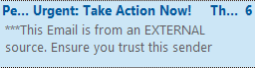
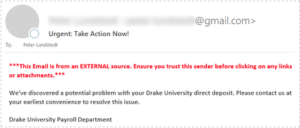
As a reminder, email labeling is an automated process that does not examine message content, only the message sender. This labeling does not indicate whether a message is malicious, it just informs recipients that message is not from a Drake sender. Every email you receive, especially those from unknown senders and/or containing links or attachments should be carefully reviewed before acting.
Please contact me with any questions, at informationsecurity@drake.edu.
— Peter Lundstedt, ITS
Many people mistakenly believe they are not a target for cyber attackers: that their data or accounts are not valuable. This could not be further from the truth. If you use technology, at work or at home, you are a worthwhile target. But you also have the best defense there is against these attacks–you.
Why they target us
Attackers have different motivations and believe that by hacking you they can achieve their goals. Here are two common examples of types of attackers and why they target us:
Cyber Criminals: They are motivated by money, and the internet ensures they can easily target a broad audience. There are MANY ways they can make money from you including:
Targeted Attackers: These are highly trained cyber attackers, often working for governments or criminal syndicates. You may feel your job would not attract much attention, but you would be very surprised.
The myth: I use an antivirus tool, I’m safe
Our suite of security tools prevents these attacks from being successful, right? Unfortunately, that’s not always true. Cyber attackers constantly improve their methods to bypass detection and protection technology. If they create new malware, it can spread undetected. Customized phishing attacks bypass email filters, and phone calls can trick you out of your credentials or money. Technology plays an important role in protection, but YOU are the best defense.
Slow down and take a close look at emails that are particularly urgent, odd, or suspicious. Use a strong, unique passphrase for each of your accounts. Staying cyber-aware is ultimately your best defense.
I invite you to email informationsecurity@drake.edu to continue this conversation or to report any suspected attacks. ITS will continue to provide phishing education in July using simulations of common attack methods.
—Peter Lundstedt, ITS

![Changes coming to [External Email] labeling](https://oncampus.wp.drake.edu/wp-content/uploads/sites/88/2019/06/2019-07-02_EmailLabelPreview.png)