All posts by Ashton Hockman

Professor of art and design researching Civil War art

Building on her scholarship on artwork about the American Civil War, Maura Lyons, professor of art and design at Drake, is spending her summer at the Indianapolis Museum of Art (IMA) at Newfields, researching a painting in the collection called Our Flag. Her plan is to combine an art historical analysis of the painting with a scientific analysis to be conducted by the conservation lab at the IMA.

Lyons is at the museum—along with her husband, Windsor Professor of Chemistry Mark Vitha, who is working in the conservation lab on a number of projects—at the invitation of Greg Smith, the senior conservation scientist at the IMA.

“When the opportunity arose to conduct research this summer connected to the collections of the Indianapolis Museum of Art, I took a look at their holdings online,” Lyons said. “I noticed that they owned a painting by Frederic Church that I was not aware of.”

According to the IMA, Our Flag is a symbolic image of America during the Civil War. It was completed in 1864 and, according to Lyons’ research, is not based on a single landscape. Rather, it seems to be a combination of features of several different landscapes, including the rocky coast of Maine and tropical landscapes in South America.

Lyons has published several articles about the role of landscape symbolism in artworks from the Civil War era, which have appeared in American Art, a journal of the Smithsonian Institution; Public Art Dialogue; Panorama: Journal of the Association of Historians of American Art; and most recently, Nineteenth-Century Art Worldwide.

“An analysis of Our Flag seemed a way to extend that research,” she said. “I am intrigued by the way that this painting is one of the few explicit statements that Church made about the war in his art, and he did so by placing a flag flying from a flagpole at the top of a mountain.”

Lyons said working with Smith will provide an opportunity to learn about the technical aspects of the painting, such as specific pigments used by the artist, changes in the paint layer, and detecting any underdrawings by the artist. Equally as important, it has allowed her to understand more about the actual painting materials through the in-house scientific lab.

The conservation lab at the IMA has allowed Lyons to interact with conservators and conservation scientists. She said these professionals have spent their careers dedicated to visual art, although they come from a different perspective compared to hers as an art historian.

“I find it exciting to be challenged to consider artworks in new ways,” she said.

Lyons shared that one of the most interesting experiences so far this summer has been a discussion she had with Our Flag’s conservator, David Miller, who restored the painting in the early 1990s. Their discussion included how the painting had a lot of damage, as well as some clumsy past restorations and she lauded how he helped return it to its former glory.

“I loved the chance to hear what that process was like, and what he saw in the painting. This has been a good reminder to me not to forget that artworks are material objects, composed of specific materials, with their own physical history,” said Lyons. “It’s always rewarding to see works of art in person rather than in reproduction.”

Lyons also shared that working as a research scholar this summer has already provided many learning opportunities.

“We talk at Drake about fostering life-long learning, and I have seen the benefits this summer of stepping out of my comfort zone and learning from others’ expertise,” said Lyons.

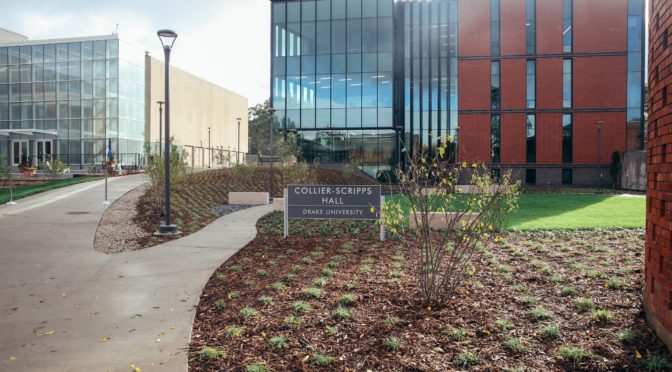
Drake University awarded Two Green Globes rating for new buildings

Drake University is pleased to announce that it earned a rating of Two Green Globes for the construction of its newest academic buildings, the Science Connector Building and Collier-Scripps Hall. The project, part of the STEM@DRAKE initiative, is the second in Iowa to earn the Two Green Globes rating, and the first on Drake University’s campus.

“Achieving a rating of Two Green Globes is a testament to the University’s commitment to sustainability,” said Drake University President Marty Martin. “These buildings will serve our students, faculty, staff, and community for years to come in ways that should make the entire community proud.”

Administered by the Green Building Initiative (GBI), Green Globes is a nationally recognized green rating assessment and certification tool that ensures projects meet high standards in environmental, water, and energy efficiency. The certification demonstrates the University’s commitment to environmental sustainability, and puts it one-step closer to achieving its goal of reducing its carbon footprint by 25 percent.

“We are proud to be a leading institution when it comes to environmental efficiency practices,” said Drake Executive Director of Facilities Planning and Management Kevin Moran. “From the very beginning, we worked closely with skilled professionals to create a design that would exceed sustainability standards.”

The Science Connector Building and Collier-Scripps Hall received a Two Green Globes rating due to sustainable features such as:

  • White roof and concrete to promote indoor cooling
  • Energy-efficient windows to reduce the buildings’ electricity use and draw daylight indoors
  • Drought-tolerant plantings so that watering is not required
  • More than the recommended amounts of insulation in the roof and walls to decrease heating and cooling demands
  • Energy efficient LED lighting fixtures inside and outside the buildings
  • Sensors that power down light fixtures when an area is not in use
  • Easy access to public transportation and rental bicycles
  • Low flow water fixtures to reduce water usage
  • Recycling facilities conveniently located throughout the building
  • Excellent indoor air quality
  • Extensive use of materials with little to no volatile organic compounds (VOCs)

The Science Connector Building and Collier-Scripps Hall opened their doors to students last August as part of the University’s STEM@DRAKE initiative. The buildings help form a central hub on campus for classes in the sciences, technology, education, and mathematics.

Meditation instructors wanted

Human Resources is exploring the possibility of offering an on campus meditation class. If you are currently a meditation instructor, or know of an instructor who leads meditation classes, please email linda.feiden@drake.edu.

Meditation has many benefits. It reduces stress, improves concentration, increases self- awareness, and may improve your sleep and help control pain. If you are interested in participating in a meditation class, please contact Linda Feiden as well.

Linda Feiden, Human Resources

Welcome new Bulldogs

In June, Drake welcomed seven new, full-time employees to the Bulldog family.

Christine Urish, Professor, Occupational Therapy, CPHS
Sara Johnston, Associate Professor, Occupational Therapy, CPHS
Molly Halverson, Administrative Assistant/Communication Coordinator, CPHS
Kristin Economos, Director, Student Leadership Programs, Student Life
Tabitha Choquette, Program Coordinator, The Robert D. & Billie Ray Center
Jeffrey McVey, Campus Public Safety Officer 1, Public Safety
Jeffrey (Jeff) Currie, HVAC Mechanic, Facilities Planning & Management

— Laura Schwarz, Human Resources

Apply now to be a mentor or mentee

The All Staff Council Special Interest Committee has been crafting a new mentor program for Drake staff members. A survey link to sign up for the mentor program is now live. Staff members who are interested in being either a mentor or mentee are asked to fill out the survey. In addition, faculty members are invited to apply to be mentors.

The final deadline to sign up is Sept. 7. From there, placements will be made and the program will launch during the fall semester.

Visit drake.edu/asc/specialinterest to learn more about and apply for the new program.

For questions, contact Carla Herling, committee chair, at carla.herling@drake.edu or 515-271-2356.

Niki Smith, University Communications/All Staff Council

Banner 9 project update

ITS is excited to share that Banner 9 Admin Pages are now available in production and our campus launch has begun. A special thank you to the Registrar’s Office, Human Resources, Finance Office, and other members of the project team who have been working diligently for over a year and a half.

Here are a few highlights about the upcoming rollout:

  • Current Banner users will be invited to one or more training sessions to learn general Banner 9 navigation along with any changes specific to their area.
  • Banner 9 will be accompanied by new required security methods for current Banner users to better protect campus data. Ahead of Banner 9 training, each user will receive an invitation to sign up for Duo, a multi-factor authentication tool. Use of Duo verifies anyone logging into Banner, and ensures that their username and password haven’t been compromised.

Banner Training Timeline:

Human Resources Pages: Live now
Student Pages: July—September
Finance Pages: Early September (followed by budget office manager training in early November)
Financial Aid Pages: Mid to late September

It may be somewhat challenging through the end of December as some current users work in Banner 8 and others in Banner 9. We appreciate your patience and cooperation during this time of transition.

Kris Brewster, ITS

DUSCI leadership change

Beginning Aug. 1, there will be a new director of the Drake Undergraduate Science Collaborative Institute (DUSCI). Brian Gentry, associate professor of pharmacology from the College of Pharmacy and Health Sciences, will step into the director role, replacing John Gitua, associate professor of Chemistry from the College of Arts and Sciences. John diligently served as director for the past five and half years.

Brian has been an active member of DUSCI for many years. He has served as a DUSCI faculty advisory board member, has been a student research mentor for summer research students, and has been active in DUCURS as a moderator/judge every year.

Kayla Jenkins, College of Arts & Sciences