Category Archives: News & Achievements Archive

Dean Renae Chesnut receives two national AACP awards

Renae Chesnut, dean of Drake’s College of Pharmacy and Health Sciences, was the recipient of two prestigious awards at the American Association of Colleges of Pharmacy’s (AACP) annual meeting July 21—25 in Boston.

Chesnut received the James Robertson, Jr. Leadership Excellence in Student Services Award, and the inaugural Sustained Contribution to Administrative Practice in Pharmacy Education Award.

Both awards recognize Chesnut’s outstanding commitment to pharmacy education. The James Robertson, Jr. Award recognizes an outstanding individual who has demonstrated leadership excellence in student services throughout his or her career. The award honors Chesnut’s commitment and leadership to the development of student services and programming at Drake as well as nationally through efforts that enhances students’ success, professional development, and increases diversity and interest in the pharmacy profession.

The award for sustained contribution to administrative practice in pharmacy education recognizes Chesnut’s work over the past several years in the creation of the Association’s Administrative Services Section, an interdisciplinary forum for pharmacy education faculty and staff in administrative positions.

In a supporting nomination letter, Drake University Provost Sue Mattison praised Chesnut noting that she is “an extraordinary leader of the College of Pharmacy and Health Sciences. Dr. Chesnut’s long and dedicated service to students in the College is testament of her commitment to facilitating students’ achievement, and is key to the outstanding success and reputation of the program. She is most worthy of these award recognitions.”

“I am humbled to have received these awards,” shared Chesnut. “I had the opportunity to know and work with James Robertson, Jr., which makes it a great honor to have received the award that continues his legacy of championing student success.”

Chesnut began her academic career at Drake 25 years ago, serving as director of student services, assistant dean, associate dean, and now dean of CPHS. She has been instrumental in the development and implementation of several initiatives that have enhanced the College’s reputation. These initiatives include implementing the Health Sciences, Occupational Therapy Doctorate (OTD) and Master’s in Athletic Training (AT) programs, as well as the pre-professional OTD and AT programs; supporting the creation of joint degree programs, including the PharmD/MPA, PharmD/MBA, and PharmD/JD; and facilitating the work of the DELTA Rx Institute, which promotes entrepreneurial leadership in pharmacy. Chesnut’s service to AACP has included chairing the AACP Student Services Special Interest Group, and the Pharmacy College Admissions Test (PCAT) Advisory Council.  She has also served as the inaugural chair of both the Association’s Student Affairs Committee, and the Administrative Services Section.

Professor of art and design researching Civil War art

Building on her scholarship on artwork about the American Civil War, Maura Lyons, professor of art and design at Drake, is spending her summer at the Indianapolis Museum of Art (IMA) at Newfields, researching a painting in the collection called Our Flag. Her plan is to combine an art historical analysis of the painting with a scientific analysis to be conducted by the conservation lab at the IMA.

Lyons is at the museum—along with her husband, Windsor Professor of Chemistry Mark Vitha, who is working in the conservation lab on a number of projects—at the invitation of Greg Smith, the senior conservation scientist at the IMA.

“When the opportunity arose to conduct research this summer connected to the collections of the Indianapolis Museum of Art, I took a look at their holdings online,” Lyons said. “I noticed that they owned a painting by Frederic Church that I was not aware of.”

According to the IMA, Our Flag is a symbolic image of America during the Civil War. It was completed in 1864 and, according to Lyons’ research, is not based on a single landscape. Rather, it seems to be a combination of features of several different landscapes, including the rocky coast of Maine and tropical landscapes in South America.

Lyons has published several articles about the role of landscape symbolism in artworks from the Civil War era, which have appeared in American Art, a journal of the Smithsonian Institution; Public Art Dialogue; Panorama: Journal of the Association of Historians of American Art; and most recently, Nineteenth-Century Art Worldwide.

“An analysis of Our Flag seemed a way to extend that research,” she said. “I am intrigued by the way that this painting is one of the few explicit statements that Church made about the war in his art, and he did so by placing a flag flying from a flagpole at the top of a mountain.”

Lyons said working with Smith will provide an opportunity to learn about the technical aspects of the painting, such as specific pigments used by the artist, changes in the paint layer, and detecting any underdrawings by the artist. Equally as important, it has allowed her to understand more about the actual painting materials through the in-house scientific lab.

The conservation lab at the IMA has allowed Lyons to interact with conservators and conservation scientists. She said these professionals have spent their careers dedicated to visual art, although they come from a different perspective compared to hers as an art historian.

“I find it exciting to be challenged to consider artworks in new ways,” she said.

Lyons shared that one of the most interesting experiences so far this summer has been a discussion she had with Our Flag’s conservator, David Miller, who restored the painting in the early 1990s. Their discussion included how the painting had a lot of damage, as well as some clumsy past restorations and she lauded how he helped return it to its former glory.

“I loved the chance to hear what that process was like, and what he saw in the painting. This has been a good reminder to me not to forget that artworks are material objects, composed of specific materials, with their own physical history,” said Lyons. “It’s always rewarding to see works of art in person rather than in reproduction.”

Lyons also shared that working as a research scholar this summer has already provided many learning opportunities.

“We talk at Drake about fostering life-long learning, and I have seen the benefits this summer of stepping out of my comfort zone and learning from others’ expertise,” said Lyons.

Drake University awarded Two Green Globes rating for new buildings

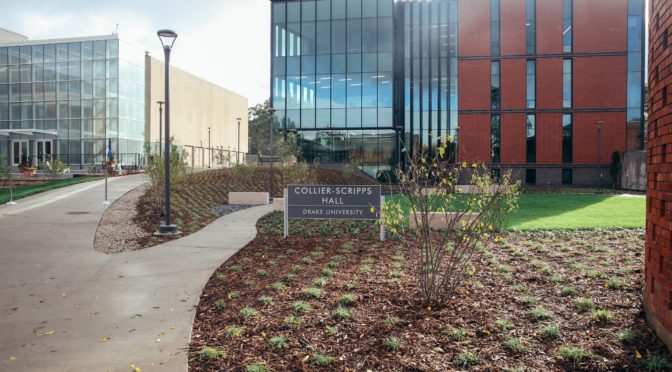
Drake University is pleased to announce that it earned a rating of Two Green Globes for the construction of its newest academic buildings, the Science Connector Building and Collier-Scripps Hall. The project, part of the STEM@DRAKE initiative, is the second in Iowa to earn the Two Green Globes rating, and the first on Drake University’s campus.

“Achieving a rating of Two Green Globes is a testament to the University’s commitment to sustainability,” said Drake University President Marty Martin. “These buildings will serve our students, faculty, staff, and community for years to come in ways that should make the entire community proud.”

Administered by the Green Building Initiative (GBI), Green Globes is a nationally recognized green rating assessment and certification tool that ensures projects meet high standards in environmental, water, and energy efficiency. The certification demonstrates the University’s commitment to environmental sustainability, and puts it one-step closer to achieving its goal of reducing its carbon footprint by 25 percent.

“We are proud to be a leading institution when it comes to environmental efficiency practices,” said Drake Executive Director of Facilities Planning and Management Kevin Moran. “From the very beginning, we worked closely with skilled professionals to create a design that would exceed sustainability standards.”

The Science Connector Building and Collier-Scripps Hall received a Two Green Globes rating due to sustainable features such as:

  • White roof and concrete to promote indoor cooling
  • Energy-efficient windows to reduce the buildings’ electricity use and draw daylight indoors
  • Drought-tolerant plantings so that watering is not required
  • More than the recommended amounts of insulation in the roof and walls to decrease heating and cooling demands
  • Energy efficient LED lighting fixtures inside and outside the buildings
  • Sensors that power down light fixtures when an area is not in use
  • Easy access to public transportation and rental bicycles
  • Low flow water fixtures to reduce water usage
  • Recycling facilities conveniently located throughout the building
  • Excellent indoor air quality
  • Extensive use of materials with little to no volatile organic compounds (VOCs)

The Science Connector Building and Collier-Scripps Hall opened their doors to students last August as part of the University’s STEM@DRAKE initiative. The buildings help form a central hub on campus for classes in the sciences, technology, education, and mathematics.

SJMC hosts Media Now Drake camp

Drake SJMC is currently hosting almost 80 high school students and their advisers from around the country for Media Now Drake, a three-day intensive journalism boot camp July 8-11. Students choose from tracks focused on design, yearbook, writing, video, web, sports reporting, photography, and editorial leadership, taught by professionals and the nation’s best high school teachers. Their advisers network and receive teaching advice. Participants receive the full Drake student experience: staying in Jewett Residence Hall, eating in Hubbell Dining Hall, and taking field trips around the Des Moines metro area. This is the third year of Media Now Drake, and many of the campers eventually join us as SJMC first-years.

Kathleen Richardson, School of Journalism and Mass Communication

Architectural preservation experts to tour Meredith Hall

The Drake School of Journalism and Mass Communication will host a tour on Thursday, July 19, in conjunction with the National Alliance of Preservation Commissions forum in Des Moines. Conference attendees will tour Meredith Hall, which opened in 1965 and was designed by famed architect Mies van der Rohe. The tour will include a discussion of the building’s history and a presentation by architects who are working on plans to update the building. The group will then tour the Scott Chapel at Medbury Hall, which was designed in 1955 by Eero Saarinen.

Kathleen Richardson, School of Journalism and Mass Communication

Drake Volleyball in Costa Rica

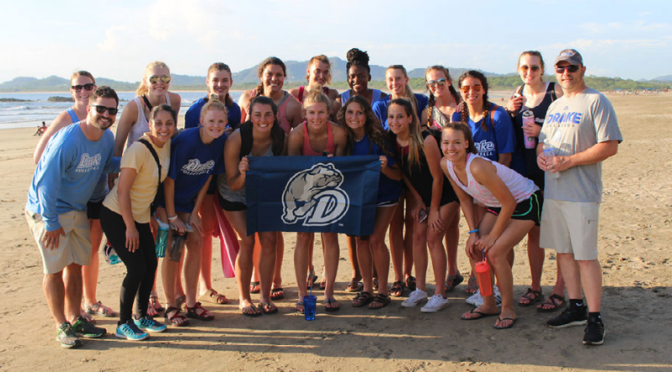
The Drake Volleyball team visited Costa Rica where they played four matches that included a win over Costa Rica’s national team. They also conducted youth clinics, donated more than 100 sports bras as part of The Sports Bra Project, and watched the NORCECA U19 Championship to cheer on the USA team against Cuba. Of course, the team also enjoyed some leisure time surfing, experiencing Costa Rica’s diverse culture, and zip lining in the rainforest.

Visit GoDrakeBulldogs.com/DUVBCostaRica to learn more about their trip.

SJMC public relations campaign wins national award

Work produced by the Drake SJMC public relations seniors in spring 2017 recently won a 2018 Clarion Award in the advertising or public relations campaign category of the national Association for Women in Communications contest.

According to the AWC website, “The Clarions—named for the medieval trumpet known for its clarity—symbolize excellence in clear, concise communications. Clarion recipients represent media companies large and small, leading corporations, small businesses, and nonprofit associations and institutions.”

The 2017 PR senior capstone client was Des Moines’ Young Women’s Resource Center. The Vector Strategies team included 2017 SJMC graduates Ashley Hawkins, Sarah Mattes, Reed Fischer, Nick Frandsen, Megan Johns and Kristen Carver.

Drake welcomes Ryan Arnold as neighborhood and community engagement manager

Ryan Arnold, Drake’s new neighborhood and community engagement manager.

Looking to enhance its relationship with the Des Moines community, Drake University is pleased to welcome Ryan Arnold to the position of neighborhood and community engagement manager.

In his new role, Ryan will establish partnerships between the University and the city, serve as the primary contact for residents and business owners in the Drake Neighborhood, and strive to strengthen the overall economic development and vitality of the area.

Ryan, who previously served as the senior minister at First Christian Church and lives in the Drake Neighborhood, has a deep understanding of the community.

“My family and I have called the Drake Neighborhood home for the last four years,” said Ryan. “I’m looking forward to combining my love for this community with my passion for Drake and continuing to move toward a more equitable, neighborly future.”

Ryan’s position will play an instrumental role in the University’s recent development projects, like the construction of a hotel, apartments, urban-style row houses, and retail space along University Avenue and the Gregory & Suzie Glazer Burt Boys and Girls Club on the southwest corner of 25th Street and Forest Avenue.

Ryan’s office is located in the Alumni House. He can be reached at ryan.arnold@drake.edu. Please welcome Ryan, his wife Kristyn, and their two children, Jack and Ellie, to the Bulldog family.

Celebrating the life of former Drake President and Iowa Governor, Robert D. Ray

Governor Robert D. Ray, BN’52, LW’54

The following message was sent to campus by President Martin on July 8:

“With a heavy heart, I am writing to share that our cherished friend, distinguished alumnus, and former colleague, Robert D. Ray, died this morning. Governor Ray proudly served as Iowa’s 38th governor and, later in his career, as the 11th president of Drake University, from April 1998 to May 1999. He received his B.A. in business from Drake in 1952, and his juris doctorate from Drake Law School in 1954.

Governor Ray is survived by his beloved wife, Billie, three daughters, and eight grandchildren. Plans for celebrating his life are pending, and will be announced at a later time.

Governor Ray had a tremendous impact on Iowa, the United States, and the world. In similar fashion, he served his beloved alma mater exceptionally well. His legacy will live on, of course, through the great work of The Robert D. and Billie Ray Center; the Robert D. Ray Collection of political and personal papers and memorabilia from Governor and Mrs. Ray, archived at Cowles Library; the RaySociety, Drake University’s lifelong learning organization; and the Ray Promenade, a beautiful plaza to be dedicated on campus this fall.

Please join me in remembering Governor Ray, and in supporting his family at this difficult time.” Marty Martin, President

Details of funeral, observances

Governor Ray will lay in state at the Iowa Capitol building Thursday, 5:30–8:30 p.m. Iowa Air and Army Guard troops, Iowa State Troopers, and the Des Moines Police will lead a procession of vehicles along University Avenue from west to east at approximately 4 p.m. as they travel toward the Capitol. Faculty and staff are welcome to show their support for Governor Ray and his family by standing along University Avenue as the procession passes by.

The motorcade will bring the governor into the first floor Rotunda where a brief ceremony will occur at 5 p.m. Those wishing to pay their respects at the Capitol should arrive early, as security checkpoints will be utilized.

The funeral for Governor Ray will be held Friday at the First Christian Church at 25th and University Avenue in Des Moines. The service will begin at 1 p.m. There will be limited seating. However, those wishing to observe and celebrate the life of Governor Ray can view a live stream of the service. Details of the live stream will be made public soon.

In lieu of flowers, memorials may be sent to The Robert D. and Billie Ray Center on campus, located at 2507 University Avenue. Remembrances may also be left on The Ray Center website.

Statement from the family of Governor Robert D. Ray
Biography of Governor Robert D. Ray

The Iowa Board of Medicine honors Zagoren with service award

Kyle Ulveling (left), chair of the Board, and Mark Bowden (right), executive director of the Board, present Dr. Allen Zagoren with an award for his long-standing service as a Board member.

The Iowa Board of Medicine recognized Dr. Allen Zagoren, associate professor of practice in public administration, for his distinguished service to the Board during the organization’s annual meeting on June 8. Dr. Zagoren has served on the Board for nearly 15 years.

Dianna Gray, College of Business & Public Administration