Category Archives: For Faculty Archive

Mental Health Awareness Month: Tips for self-care

As you may have read, May is Mental Health Awareness Month. Making time for self-care is an important component to maintaining mental health. There is a wealth of knowledge on this topic.  This article touches on just a few ideas and includes links if you wish to explore the topic further.

Stockpile coping tactics: Try collecting different coping skills and self-care strategies to keep in your back pocket. By adding tools, tactics, and strategies to your self-care toolbelt, you become less reliant on unhealthy practices (say, stress eating) and don’t wear out your tried-and-true healthy practices (you can’t always go for an hour long walk to clear your mind).

Explore the Self-Care Wheel to identify such tools, tactics, and strategies in these six different areas:

  1. Physical
  2. Psychological
  3. Emotional
  4. Professional
  5. Personal
  6. Spiritual

 Make a little time to work through the exercise of completing your very own Self-Care Wheel here.

Cut yourself some slack: The way we speak to ourselves can affect us much more than we realize. It’s easy to beat ourselves up over mistakes, sticking our foot in our mouth, or falling short against unreasonable self-expectations. Self-compassion means being inwardly understanding, encouraging, and kind in the face of setbacks—a reaction we commonly extend to friends, colleagues, and family members but sometimes forget when it comes to ourselves. Try talking to yourself as you would a best friend or someone you are mentoring. When we are our own #1 fans, we increase our confidence and boost our mood. It’s important to give everyone—friends, family, colleagues, and ourselves—room to be human. It is still important to learn and grow from mistakes, but dwelling on them doesn’t do you any good.

Move more. Physical activity can help the brain cope better with stress, making it beneficial in the treatment of depression and anxiety symptoms. Regular physical activity has also been demonstrated to strengthen the immune system. And you can turn your exercise routine into a way to spend more time outdoors. Studies have shown that spending time outdoors can help reduce fatigue, making it a great way to manage symptoms of depression or burnout. We are so fortunate to have miles and miles of trails in the Des Moines area and loads of state and city parks nearby, too.

Don’t hesitate to ask for help. Sometimes it is hard to accept that we need help (eliminating stigma about seeking mental health support is part of the purpose of Mental Health Awareness Month!). If you’re feeling overwhelmed, stressed, depressed, or anxious, remember to speak up and lean on those around you–family, friends, colleagues. If asking for help is a source of discomfort and you’re not sure how to get the help you need, Drake offers benefits for this. See last week’s OnCampus piece on mental health services available through Broadlawns and Drake’s Employee Assistance Program (EAP), which offers free and confidential counseling options.

Keep reading!

— Maureen De Armond, Human Resources

Deputy Provost 2:10: Close of Spring 2022

We are not ending the semester as we had hoped, and it is worthwhile to pause and acknowledge what, to many, is a sense of disappointment.  I know I always loved the time I spent with students during finals week—getting to see them one last time in person before sending them toward summer (and their futures).

It is also important to note that, given the shift to online class meetings during finals week, many faculty are engaged in rethinking how they will assess student learning at the close of the semester.  It is also true that many of your students may be experiencing illness related to being COVID-19 positive, and may be asking for extensions on that work.  This message provides some critical information, suggestions, and guidance.  It can be found on the website of the Center for Teaching Excellence along with additional resources on virtual teaching and learning.

 Final grades are due to be submitted on Wednesday, May 18, at 10 a.m. If a student or group of students in your class needs an extension for turning work in, it would be appropriate to use an Incomplete.  When you enter an Incomplete, you will be required to enter a deadline for the extension and a default grade if the work is not completed.  I recommend not choosing the “default” extension deadline, but rather choosing a deadline that is appropriate to the situation (yours and the students’) and the amount of work to be accomplished in service of a grade.  I acknowledge this—entering an Incomplete—requires an extra step for faculty as you are entering grades, and it requires follow-up on your part; this, though, the most accurate representation of the grade-in-progress, and a humane and compassionate way to deal with student needs.  Entering an Incomplete gives faculty the ability to update the grade via Self Service once the work is complete.   

Faculty may also want to rethink the way that we assess student achievement of learning outcomes in the course.  Faculty could consider offering open book/note/resources essay exams rather than a traditional in-class, resource blind format, for instance; faculty could consider presentations over Zoom in place of in class finals and presentations, or alternative assignments to group projects where groups are impacted by Covid.  Faculty may also want to engage in online assessment, and I’m happy to provide here some guidance from our Instructional Technologists, to accomplish that.

Recommendations for creation and use of online assessments  

  • If you will be creating an assessment for your final, please author that assessment in your Blackboard course. This will save you the effort of having to cut and paste to create questions if you author in a separate document.
  • If you already have a document prepared, cutting and pasting the questions into the course is the most expedient way to get questions built online.
  • If you will have a written exam or part of your exam will be written, be clear on the format you expect students to submit for grading. (i.e. “upload a Word document to the assignment” OR “in the answer space provided, please answer this question…. uploaded documents will not be accepted or graded.”)
  • Be aware that matching, multiple choice, and true false questions are automatically graded. Essay questions will need to be graded manually. Assessment scores will not show to students until all questions are graded and the scores are posted.
  • If you have previous exams in your course, consider reusing questions from those assessments. This can be done selecting the Reuse questions option when creating a question.
  • Consider randomizing test questions and answers if possible. This will effectively create a unique exam for each student.
  • If you have not previously used LockDown browser during the semester, we strongly encourage you not to consider its use for the final. The successful deployment of an exam with LockDown browser requires a series of steps which must be done in the proper order. This includes students being able to download, install, and run the client on their own computers or devices and having a reliable network connection throughout the entire exam.

Creating Assessments

For directions on how to create assessments please see the Blackboard support page. 

Please use these resources which provide the best practices in online testing preparation for instructors.   

Please provide these resources to students, re: best practices in online testing. And, please share these resources for students prior to your testing period so that they may be prepared ahead of time as well.

Requesting Assistance

As always, please remember that the Academic and Emerging Technologies team provide support and Drake Online have instructional designers and technologists who can help with troubleshooting both technical and pedagogical issues that involve educational technology use.

To request help from Academic and Emerging Technologies, please use: https://drake.teamdynamix.com/TDClient/2025/Portal/Requests/ServiceDet?ID=51078

To request help from Drake Online, please use: https://drake.teamdynamix.com/TDClient/2025/Portal/Requests/ServiceDet?ID=47962

To request help in designing or rethinking end-of-term assessments, conversation about meeting students’ needs in reasonable ways, or moral support and gratitude in general from the Deputy Provost, please email: renee.cramer@drake.edu.

Renée Cramer, Deputy Provost

Drake Social rescheduled for May 18

You are invited to the next Provost’s Drake Social Wednesday, May 18, in the Cowles Library Reading Room beginning at 4 p.m.

During this event, faculty and staff who celebrated (or will be celebrating) a milestone anniversary or retirement between July 1, 2021, and June 30, 2022, will be highlighted. Their names will be scrolled on video screens around the room.

Those who celebrated a milestone service anniversary between July 1, 2019, and June 30, 2021, are also encouraged to attend. We were unable to hold this event in May 2020 or 2021 due to COVID restrictions.

There will be soft drinks, wine, beer, and light snacks. Take a moment to stop by and congratulate your co-workers!

— Drinda Williams, Office of the Provost

Deputy Provost 2:10: Cathy Davidson, link to presentation

I know many of you were not able to make it to the live event featuring Cathy Davidson, author of The New Education: How to Revolutionize Higher Education to Prepare Students for a World in Flux so I am happy to be able to provide a link to it here, for those who might wish to watch and discuss.

We will be doing a book group when the new version of the text is finally released (there are delays), and reading her newest text, on individual classroom practices, as part of Books for Breakfast, next fall!

Renée Cramer, Deputy Provost

Seeking faculty fellow for CEL

The Drake Mission, Drake Commitment, Continuous Improvement Plan, and Every Bulldog a Changemaker priority of The Ones Campaign, all promote community engagement as a signature strength of a Drake education. Thanks to funding from the Slay Fund for Social Justice and the Olson Endowment for Global Service-Learning, the Office of Community Engaged Learning is able to support two faculty fellows to advance the work of community engaged learning on Drake’s campus. Fellows serve a one-year term beginning July 1 and receive a $3,000 stipend.

See our faculty fellows page for full position descriptions and application instructions or contact Renee with questions. Applications are due May 20, 2022.

— Renee Sedlacek Lee, Community Engaged Learning

Offices of the Provost and HR launch faculty recruitment project

The Offices of the Provost and Human Resources are excited to initiate a collaborative project re-envisioning faculty recruitment at Drake. The project team consists of Jennifer Harvey, Ann Guddall, and Drinda Williams in Academic Affairs; Maureen De Armond and Marli Jefferson in Human Resources; and with Renée Cramer and Sue Mattison as the project’s executive sponsors.

We will be seeking cutting edge best practices to help Drake attract and hire faculty who will help us meet our institutional goals, serve our students, and live Drake’s Core Values.

At present, the key deliverables have been identified as: (1) creating a strategic faculty recruitment guide with recommendations, templates, sample language, dos & don’ts, and other related resources designed to help solicit large, diverse pools of viable faculty applicants, adopt best practices in recruitment and hiring, and embedding consistent and legally compliant practices; (2) developing a technical guide for search chairs, hiring authorities, search committees, business office managers, HR, and the Provost Office (this will be designed to go with the new applicant tracking system that replaces Hire Touch, which will be sunset at the end of the calendar year); and (3) adopting comprehensive communication and training materials for stakeholders involved in future faculty searches.

The project team will work closely with the academic leaders to strike an appropriate balance between what aspects of faculty recruitment process and strategy should be consistent across the institution and what aspects are more appropriately tailored by the academic units.

The project team will be thoughtful in reaching out to recently hired faculty, recent search committee chairs, deans, academic chairs, business office managers of academic units, and other important stakeholders for feedback.

Since the project team will be working over the summer, it is important to capture ideas and suggestions from faculty prior to the close of the semester. The project team welcomes feedback on current strengths and weaknesses in the existing faculty recruitment processes, suggestions for new and innovative practices, or anything else that comes to mind. You are invited to email such messages to drakehr@drake.edu. Please use “Faculty Recruitment” as the email subject line and the message will be shared with the project team.

— Jennifer Harvey, Associate Provost, Campus Equity and Inclusion & Maureen De Armond, Executive Director of Human Resources

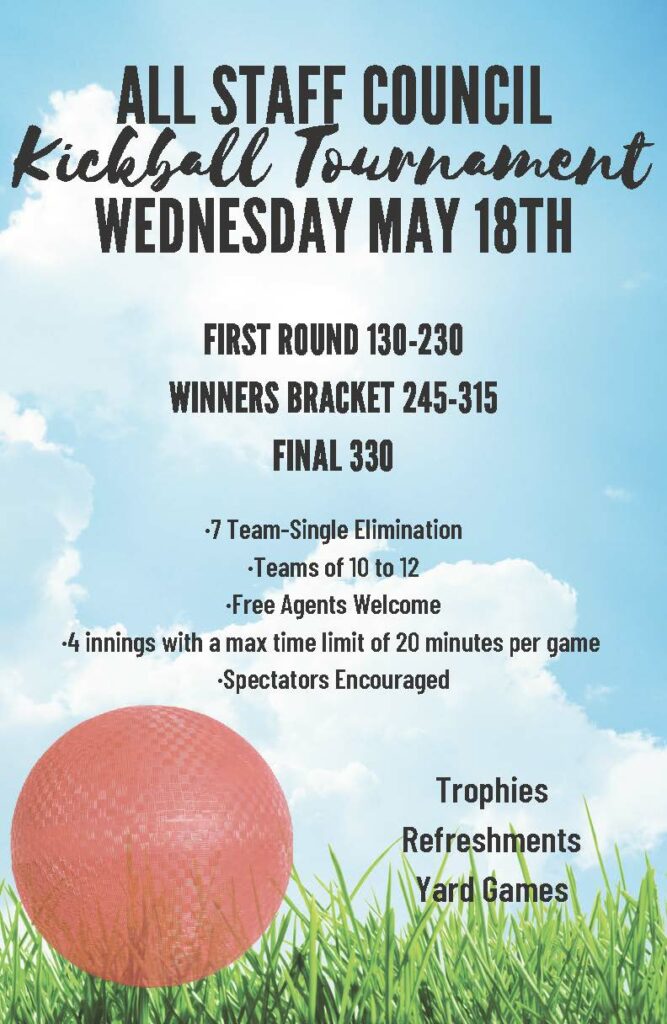
Save the date for popsicles and kickball

All Staff Council is bringing back its kickball tournament on Wednesday, May 18, to celebrate the start of summer!

Register your team or as a free agent today and view the attached flyer for details.

Spectators welcome and encouraged! Yard games and refreshments will be provided and you may enter the All Staff Council drawing for a chance to win an awesome prize. We look forward to seeing you there.

— Sydni Jennings, College of Pharmacy & Health Sciences

Fiscal year-end guidelines

With the University’s fiscal year-end (June 30, 2022) approaching, below are recommended guidelines for efficient and effective year-end processing of financial transactions.

Accounting for departmental expenses:
In accordance with generally accepted accounting principles, Drake is required to report transactions in the proper fiscal period. For that reason, expenses are recorded in the period when goods are received and/or services are rendered.

In short, items expensed to the FY22 budget will need to be received before ‘end of day’ on June 30, 2022.  Factors such as budget allocation, invoice receipt, or payment issuance would not have an impact on the application of expenses within a fiscal period.

Exceptions to this general rule apply when a benefit of service or receipt of item extends into multiple fiscal years. In such cases, the following guidelines will be applied.

  • Expenses less than $5,000: will be charged against the fiscal year in which the majority of the expense will be incurred. (For example, if a subscription is purchased for $3,000 and covers the period of 7/1/21 through 12/31/22, the expense would be charged to FY22)
  • Expenses greater than or equal to $5,000: will be split into the fiscal years according to the percentage of benefit received during each fiscal period. (For example, if a subscription is purchased for $10,000 that covers a period of 7/1/21 through 6/30/23, $5,000 would be charged to FY22 and $5,000 charged to FY23)

The University’s guidelines for year-end purchases are subject to external audit. As you make purchases during this period leading up to and overlapping our fiscal year end, it is important to note when the goods or services were received so they are expensed according to reporting requirements. If the timing of receipt is not clearly noted on the invoice, it would be beneficial to help call the receipt date to accounting’s attention by clearly noting the appropriate fiscal, based on the above guidelines, in the business description in Finance Self Service.

Please review the notice for processing year-end transactions through the new Finance Self Service tool as well as a timeline for processing year-end transactions.

For questions, contact Jeni Baugher at extension 4509 or jenifer.baugher@drake.edu.

— Jeni Baugher, Accounting