Category Archives: For Faculty Archive

Committee on Student Ready Institution Needs Your Feedback

This past spring, the Faculty Senate created an ad hoc committee focused on a review of Drake’s ability to be a student-ready institution and ways the campus community, and in particular faculty, can play a role in achieving this goal. If you are not familiar with the term, a student-ready institution provides holistic support to its students and restructures systems to support student needs.

Also, this past spring, the ad hoc committee met with campus stakeholders and assessed faculty practices and university systems related to this area to understand where we are. While this helped us develop a picture of Drake’s current practices, WE NEED YOUR HELP to better understand what faculty are already doing in this area, how faculty are using current related university systems, and what improvements can be made to achieve the goal of being a student-ready institution.

We invite you to participate in one of several faculty focus groups dedicated to assessing our university’s preparedness to be a truly student-ready institution. These sessions will gather your insight into how we currently are and, in the future, can do better to support our students and effectively prepare them for both academic success and future careers.

Please note that for efficiency, artificial intelligence will be used during the meetings to record and transcribe the discussions. The findings from faculty focus groups will be combined with data from corresponding student and staff focus groups to generate a comprehensive report outlining actionable changes and best practices for faculty and suggestions for institutional system modifications to make Drake a more student-ready institution.

Friday, Oct. 2, 9 a.m. to 11 a.m., Johansen 301: https://calendly.com/maria-valdovinos-drake/ad-hoc-student-ready-institution-focus-group-faculty3

Friday, Oct. 9, 1 p.m. to 3 p.m., Johansen 301: https://calendly.com/maria-valdovinos-drake/ad-hoc-student-ready-institution-focus-group-faculty4

— Maria Valdovinos, Professor of Psychology

First-Gen Faculty/Staff Directory

Drake defines a first-generation student is a college student whose parents/legal guardians have not received a bachelor’s degree from a four-year university.

In an effort to make more connections between first gen students and first gen faculty/staff, we are creating a directory to share on our website that lists our first gen faculty and staff. This was a project we started Fall 2025 that was put on hold due to new website. We are ready to get to work on this again.

If you identify as first generation and would like to be listed on this directory, please email Marina at marina.verlengia@drake.edu by Monday, Oct. 19.

— Marina Verlengia, New Student Programs

AI Acceptable Use Policy Open for Comment

Drake’s new Acceptable Use of Artificial Intelligence (AI) Policy is available for campus review and comment on the Policy Development and Review page of the University Policy Library internal site (Drake login required). This policy establishes standards for the acceptable use of AI technologies at Drake. It addresses the responsible use, acquisition, integration, and deployment of AI technologies. The purpose of the policy is to ensure that AI-enabled content, automation, and representations of the University are used in a manner that protects security, compliance, institutional integrity, and the rights and privacy of individuals. 

The campus comment period has been extended through Friday, October 9, 2026.

Comments may be submitted to dupolicies@drake.edu. 

— Keren Fiorenza, Chief Information Technology Officer

Religious Holiday Calendar and Notification Form

Drake University is committed to fostering a community where students, faculty, and staff can practice, observe, and engage with their religious, spiritual, and cultural traditions with respect and understanding.

The Religious Holidays Calendar highlights observances that members of the Drake community may recognize throughout the academic year. The calendar is intended to serve as a resource for awareness, planning, and fostering a more inclusive campus community. It is important to recognize that not everyone within a particular religious, spiritual, or cultural tradition observes the same holidays or practices them in the same way. Dates may also vary depending on tradition, community, calendar, or other factors. The calendar is therefore not intended to be an exhaustive list of all observances or practices.

The Faculty Senate-Religious Accommodations Policy (12/2020) allows for reasonable accommodations. Students should inform their instructor in writing of their need to observe a religious holiday or rite well in advance of their absence.

Students who anticipate missing class, an exam, or another academic activity due to a religious, spiritual, or cultural observance should communicate with their instructors as early as possible and follow Drake University’s established religious holiday notification process. The form is located on the Religious Holidays Calendar website. Faculty and staff are encouraged to work with students in accordance with university policies and to approach these conversations with flexibility and respect.

Thank you for helping us build a Drake community where individuals feel respected, supported, and able to honor the traditions and practices that are meaningful to them.

Please reach out to me at anisa.hansen@drake.edu with any questions or issues.

— Anisa Hansen, Associate Provost for Equity and Inclusion

Faculty/Staff Affinity Groups: Invite to Join

This message includes two new Affinity Groups that will be starting this year!

 Since the 2021–2022 academic year, the Office of Campus Equity and Inclusion has supported a variety of faculty and staff affinity groups designed to build community, foster belonging, and support professional well-being across campus.

If you would like to connect with any of our active affinity groups or be added to their mailing list, please reach out directly to the designated point of contact below.

Additionally, we are actively seeking a new faculty or staff champion to help lead the LGBTQ+ Affinity Group. While Terrance is currently serving as the interim point of contact to collect names and share updates, we would love to transition leadership to anyone interested in helping guide and shape this community. If you are interested in stepping into this leadership role or co-championing the group, please let Anisa know!

Affinity GroupContactEmail Address
Parents of Young Children (NEW!)Elizabeth Talbertelizabeth.talbert@drake.edu
Disability (NEW!)Sam Sheltonsam.shelton@drake.edu
LGBTQ+Terrance Pendleton (Interim)terrance.pendleton@drake.edu
Black / African AmericanTerrance Pendletonterrance.pendleton@drake.edu
JewishLilianna Bernsteinlilianna.bernstein@drake.edu
Asian American & Pacific Islander (AAPI)Jeanette Tran


Ellen Yee

jeanette.tran@drake.edu


ellen.yee@drake.edu

Latino/a/xMarina Verlengiamarina.verlengia@drake.edu
MuslimAlimoor Rezamd.reza@drake.edu

We are also always looking to expand spaces of connection on campus. If you are interested in starting a new affinity group that aligns with and advances Drake’s mission for equity and inclusion, please feel free to reach out to Anisa directly.

— Anisa Hansen, Associate Provost for Equity and Inclusion

— Terrance Pendleton, Faculty Fellow for Equity and Inclusion

Drake Athletics Faculty and Staff Appreciation Game Nights

Cheer on the Bulldogs and take advantage of a special offer just for Drake faculty and staff. For select Faculty and Staff Appreciation Game Nights, Drake employees can claim one FREE ticket and purchase additional tickets for family and friends at a special discounted rate. Come out, show your Bulldog pride, and enjoy a great night of NCAA Division I athletics with the Drake community!

https://godrakebulldogs.evenue.net/promotions/STAFF

— Tim Tesar, Athletics

Committee on Student Ready Institution Needs Your Input

This past spring, the Faculty Senate created an ad hoc committee focused on a review of Drake’s ability to be a student-ready institution and ways the campus community, and in particular faculty, can play a role in achieving this goal. If you are not familiar with the term, a student-ready institution provides holistic support to its students and restructures systems to support student needs.

Also, this past spring, the ad hoc committee met with campus stakeholders and assessed faculty practices and university systems related to this area to understand where we are. While this helped us develop a picture of Drake’s current practices, WE NEED YOUR HELP to better understand what faculty are already doing in this area, how faculty are using current related university systems, and what improvements can be made to achieve the goal of being a student-ready institution.

We invite you to participate in one of several faculty focus groups dedicated to assessing our university’s preparedness to be a truly student-ready institution. These sessions will gather your insight into how we currently are and, in the future, can do better to support our students and effectively prepare them for both academic success and future careers.

Please note that for efficiency, artificial intelligence will be used during the meetings to record and transcribe the discussions. The findings from faculty focus groups will be combined with data from corresponding student and staff focus groups to generate a comprehensive report outlining actionable changes and best practices for faculty and suggestions for institutional system modifications to make Drake a more student-ready institution.

Friday, September 18th, 9:00a to 11:00a, Johansen 301: https://calendly.com/maria-valdovinos-drake/ad-hoc-student-ready-institution-focus-group-faculty1

Friday, September 25th, 1:00p to 3:00p, Johansen 301: https://calendly.com/maria-valdovinos-drake/ad-hoc-student-ready-institution-focus-group-faculty2

Friday, October 2nd, 9:00a to 11:00a, Johansen 301: https://calendly.com/maria-valdovinos-drake/ad-hoc-student-ready-institution-focus-group-faculty3

Friday, October 9th, 1:00p to 3:00p, Johansen 301: https://calendly.com/maria-valdovinos-drake/ad-hoc-student-ready-institution-focus-group-faculty4

— Maria Valdovinos, Professor of Psychology

Call for Travel Seminar Proposals for J-Term 2028

The call for travel seminar proposals for J-Term 2028 is now open

If you are considering proposing a travel seminar, your first step is to set up a meeting with Chelsea Funk to discuss your ideas and intent to propose.

All seminars hoping to travel for J-Term 2028 must submit a proposal. There is only one proposal submission link, and all fields must be completed.

Want More Info? Travel Seminar resources are available on our Global Affairs internal site. The internal site replaces our previous PDF and has information on:

Dates & Deadlines:

  • Submission: Sunday, October 18, 2026 (11:59pm)
    • No late applications will be accepted; contact Chelsea with any questions or concerns ahead of the deadline
  • Department & Dean Approvals: Thursday, October 22, 2026
  • Decision Notification: end of October 2026

 Proposal Link & Instructions:

The proposal submission is now being collected through Via TRM (not Qualtrics).

  1. Set up your Via profile (https://drake.via-trm.com/authV2/welcome)
    • Click “Go to Portal” to use your Drake SSO credentials; accept Terms & Conditions
  2. Once signed in, use this link to locate the Travel Seminar Proposal (drake.via-trm.com/program_brochure/38102)
  3. You can read through the relevant details on the proposal landing page. When you’re ready, click “Apply” in the top right corner to open the proposal application.
  4. You may stop & save your progress at any time using the “Save” button. Once you are finished, click “Submit”.

Please contact Chelsea with any questions ahead of the deadline. The EAPIC committee looks forward to reviewing your proposals!

— Chelsea Funk, Global Affairs

Harkin Institute Announces Faculty Fellow Program and Faculty Fellow-in-Residence Program

The Harkin Institute for Public Policy and Citizen Engagement announces its Faculty Fellow Program and Faculty Fellow-in-Residence Program, which recognize Drake University faculty whose scholarship, creative activity, and public intellectual contributions align with and advance The Harkin Institute’s mission in fields related to public health, wellness, nutrition, agriculture, environmental health, retirement security, long-term care, labor and employment policy or history, or disability policy.

During their fellowship, Faculty Fellows will have opportunities to contribute to Harkin Institute projects, including research and publications; to serve as principal or associate investigators on Harkin Institute grants; to appear as panelists or presenters at Harkin Institute events; to present public lectures or presentations; and/or to take on contracted work on behalf of The Harkin Institute. They will style themselves a “Fellow of the Harkin Institute” when speaking, writing, or applying for funding related to The Harkin Institute’s mission and strategic priorities during the term of their fellowship. Tenured Faculty Fellows at the rank of Full Professor will be considered Senior Fellows.

Benefits of the fellowship include:

  • Support from THI in securing and managing grants and grant compliance.
  • Opportunities to collaborate with policy directors on current Harkin Institute projects (at the request of Fellows).
  • Research and administrative assistance from student associates, including assistance with document and presentation formatting.
  • Personalized Harkin Institute Fellow business cards.

Faculty Fellows will be included on The Harkin Institute website along with a brief bio and description of their work. Harkin Institute Faculty Fellowships are unremunerated unless (1) specific outside funding is secured in support of a fellow’s work or (2) the fellowship fulfills, in part, a faculty member’s sabbatical reassignment.

Harkin Institute Faculty Fellowships fall into two categories:

  • Harkin Institute Faculty Fellowships are unremunerated affiliations available to Drake faculty members who demonstrate high-quality, ongoing peer-reviewed research or creative activity or public scholarship in an area related to The Harkin Institute’s Mission. Faculty Fellows are not under the direction of Harkin Institute staff unless they opt to take part in a Harkin Institute grant, contract, initiative, or project. 
  • Harkin Institute Faculty Fellowships in Residence recognize Drake Faculty reassigned to The Harkin Institute during their sabbatical and whose sabbatical project contributes directly to a Harkin Institute initiative or project. Their work falls at least partly under the direction of The Harkin Institute’s executive director and a director of policy.

The deadline for application for FY 2027 Fellowships is September 25. Application materials (see below) should be emailed to harkininstitute@drake.edu. Inquiries should be sent to Craig Owens, Executive Director, cc’ing Mindy Jones, Chief of Staff and Director of Operations.

Faculty Fellows are appointed to renewable fiscal-year terms either through special invitation or via application:  

  • By Invitation: The Executive Director of The Harkin Institute will contact faculty directly with an invitation to consider accepting a one-year renewable Faculty Fellowship and to provide an updated vita for review. Deans and department chairs may nominate members of their faculty via email to the Executive Director of The Harkin Institute.  
  • By Application: Each August, OnCampus will publish a call for applications.  

Faculty Fellowship (non-residential) require (as a single document) 

  • A brief statement (350-500 words) explaining the applicant’s qualifications, including how their work intersects with the mission of the institute.  
  • The name of one professional reference who can speak to the quality of the applicant’s scholarship or creative activity.  
  • A complete, up-to-date cv. 

Faculty Fellowship in Residence: 

  • Applicants will meet in-person with the Executive Director to discuss residential opportunities in the fall of their application for sabbatical.  
  • The formal application will consist of a copy of the applicant’s sabbatical application and supporting materials, including complete, up-to-date vita. It will require that the applicant affirm that they have consulted with their dean and their department chair or program director before accepting any offer of fellowship. 
  • Fellowships in Residence require approval of the sabbatical request.  
  • Residential Fellows will spend two-to-three (2-3) days weekly in residence at The Tom and Ruth Harkin Center except when their sabbatical project requires offsite travel.   
  • Residential Fellowships require the final approval of the applicant’s dean, to be sought by a member of The Harkin Institute leadership. 

— Mandy McClure, The Harkin Institute

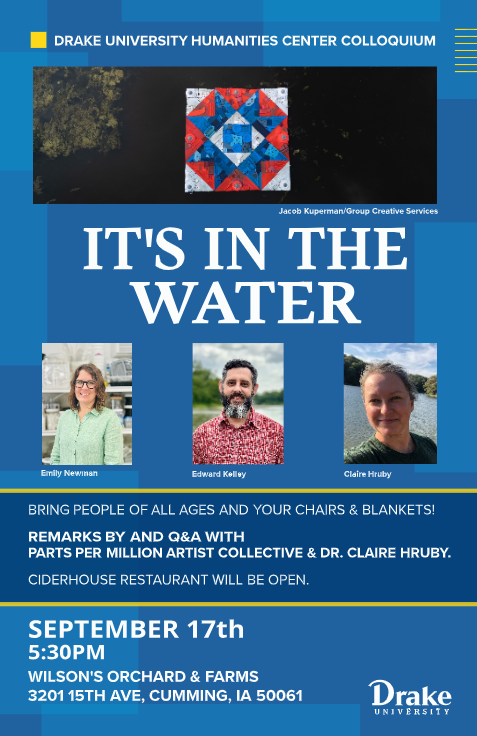
Learn About Water Quality at “It’s in the Water” Sept. 17, Wilson’s Orchard

The Humanities Center Colloquium invites you to “It’s in the Water” at 5:30 p.m. on Sept.17 at Wilson’s Orchard and Farms in Cumming (3201 15th Ave, Cumming, IA 5006)
 
Art Professors Emily Newman and Edward Kelley will share about the nitrate removal sculpture they created and installed. Environmental Science Professor Claire Hruby will help us understand more about water quality in Iowa.
 
We’ll learn about art and activism, and water and enjoy light refreshments together (Ciderhouse Restaurant will be open too).
We’ll meet at the pond and see the sculpture there while we learn, so bring lawn chairs / blankets. People of all ages / families are welcome.

— Inbal Mazar, Associate Professor of Spanish